Showing posts with label Advice. Show all posts

Monday, December 5, 2011

Advice of the Day- We're on Borrowed Time

 Charles Wheelan commencement talk;

What it means for you, and what I’ve found to be one the great challenges of adulthood, is balancing present and future. If you want to do great things in a decade or two, you need to grind away now. You need to do things that you would prefer not to do, to spend time on things that you don’t particularly enjoy. Frankly, that’s an important part of your 20s. Sorry to be the bearer of that message. But you can’t lose sight of the fact that there are no guarantees in life. If you grind away miserably to become the CEO, no one can promise you that it will work out that way, or that the sacrifice will be worth it even if it does. On the other hand, if you spend most of your time skateboarding with friends and playing video games, I can pretty much assure you that your professional accomplishments will be limited.


You have to navigate that trade-off. On this point, I do have advice, which is to take joy in the journey, rather than building your life around how good you expect the view to be when you get to the top. Again, by the way, the happiness research is clear. Most people overstate how much they will enjoy that next promotion and the stuff it can buy—because we get used to them so quickly. By next Monday, it’s another job and a bigger TV that you still can’t find the remote control for.

Sunday, November 20, 2011

Book Quote of the Day


It is no tragedy to think of the most successful people in any field as superheroes. But it is a tragedy when a belief in the judgment of experts or the marketplace rather than a belief in ourselves causes us to give up, as John Kennedy Toole did when he committed suicide after publishers repeatedly rejected his manuscript for the posthumously best-selling Confederacy of Dunces...
What I’ve learned, above all, is to keep marching forward because the best news is that since chance does play a role, one important factor in success is under our control: the number of at bats, the number of chances taken, the number of opportunities seized. For even a coin weighted toward failure will sometimes land on success. Or as the IBM pioneer Thomas Watson said, “If you want to succeed, double your failure rate.”
-Mlodinow, Leonard (2008-05-13). The Drunkard's Walk: How Randomness Rules Our Lives (p. 217). Vintage. Kindle Edition.

Friday, August 5, 2011

The Art of Listening- RASA

Highly recommended talk by Julian Treasure (rating 5 out of 5);

RASA- Receive, Appreciate, Summarize, Ask

Silence
Help them to experience this possibly for the first time in their lives. Teach about it (take a look at my blog on silence for some ideas) and then work up from short shared silences - maybe one minute to start with - to longer ones. This will be very precious for them, but also very challenging. Ask them to write or share their experience of these silences, and what silence means in their lives.

Mixer
Take them to rich aural environments (start inside the school) and have them pair and log all the sound sources they hear. If you have the resources, let them experiment with multichannel sound.

Savouring
Give them a multi-day project to notice sounds and bring their three favourites in to class to share. If you have the resources (eg own a Zoom H2 digital recorder or similar) do this one small group at a time and have them record the sounds to play to all. You could do the same with sounds they dislike.

Listening positions
The most powerful of all. Pair them up and have A say what they had for breakfast while B listens from different positions (for example 1 I'm bored; 2 I want to be friends with this person; 3 I'm in a hurry; 4 what can I learn from this - please make up your own also). Have the As share their experiences at the end, then the Bs. Swap and repeat. If they get the principle that you can change reality by listening from a different place, that will be a great gift.

RASA (receive, appreciate, summarise, ask)
Practice each element by pairing up again and have listeners turn each element off and on while listening and then both people share their experience. Have them share about their general experience of being listened to at home, in school and elsewhere (especially by adults), and how it affects their own listening to others.

Saturday, December 4, 2010

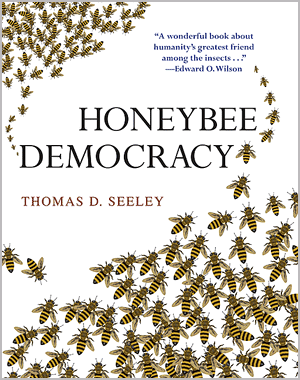
Learn from Bees

In the final chapter, Seeley suggests five lessons we could learn from bees.

• Compose a decision-making group of individuals with shared interests. Here bees have a higher stake than us: all members of a colony are related (sisters) and nobody can survive without the group.

• Minimise the leader's influence on the group. Here we humans have much to learn.

• Seek diverse solutions to the problem. Humans realised only recently that diversity is good for a group.

• Update the group's knowledge through debate. Here again, bees are superior to us, as each scout's "dances" become less effective with time, no matter how good a new site is, while stubbornness can lead humans to argue forever.

• Use quorums to gain cohesion, accuracy and speed. Impressively, bees came up with this concept long before the Greeks.

Thursday, September 16, 2010

Non Muslims and Koran

Robert Wright makes an interesting point about interpretation of scriptures;

All the Abrahamic scriptures have all kinds of meanings — good and bad — and the question is which meanings will be activated and which will be inert. It all depends on what attitude believers bring to the text. So whenever we do things that influence the attitudes of believers, we shape the living meaning of their scriptures. In this sense, it’s actually within the power of non-Muslim Americans to help determine the meaning of the Koran. If we want its meaning to be as benign as possible, I recommend that we not talk about burning it. And if we want imams to fill mosques with messages of brotherly love, I recommend that we not tell them where they can and can’t build their mosques.

Of course, the street runs both ways. Muslims can influence the attitudes of Christians and Jews and hence the meanings of their texts. The less threatening that Muslims seem, the more welcoming Christians and Jews will be, and the more benign Christianity and Judaism will be. (A good first step would be to bring more Americans into contact with some of the overwhelming majority of Muslims who are in fact not threatening.)

You can even imagine a kind of virtuous circle: the less menacing each side seems, the less menacing the other side becomes — which in turn makes the first side less menacing still, and so on; the meaning of the Abrahamic scriptures would, in a real sense, get better and better and better.
-The Meaning of the Koran

Monday, September 6, 2010

Bertrand Russell's Three Passions

Quote of the Day;
Three passions, simple but overwhelmingly strong, have governed my life: the longing for love, the search for knowledge, and unbearable pity for the suffering of mankind. These passions, like great winds, have blown me hither and thither, in a wayward course, over a deep ocean of anguish, reaching to the very verge of despair....

With equal passion I have sought knowledge. I have wished to understand the hearts of men. I have wished to know why the stars shine. And I have tried to apprehend the Pythagorean power by which number holds sway above the flux. A little of this, but not much, I have achieved.

via Information Processing

John Grisham, the failed tax lawyer and construction worker

Effective Habits from John Grisham-

Halfway through college, and still drifting, I decided to become a high-powered tax lawyer. The plan was sailing along until I took my first course in tax law. I was stunned by its complexity and lunacy, and I barely passed the course...

When my law office started to struggle for lack of well-paying work — indigent cases are far from lucrative — I decided to go into yet another low-paying career: in 1983, I was elected to a House seat in the Mississippi State Legislature. The salary was $8,000, which was more than I made during my first year as a lawyer. Each year from January through March I was at the State Capitol in Jackson, wasting serious time, but also listening to great storytellers. I took a lot of notes, not knowing why but feeling that, someday, those tales would come in handy...

Writing was not a childhood dream of mine. I do not recall longing to write as a student. I wasn’t sure how to start. Over the following weeks I refined my plot outline and fleshed out my characters. One night I wrote “Chapter One” at the top of the first page of a legal pad; the novel, “A Time to Kill,” was finished three years later.

The book didn’t sell, and I stuck with my day job, defending criminals, preparing wills and deeds and contracts. Still, something about writing made me spend large hours of my free time at my desk.

I had never worked so hard in my life, nor imagined that writing could be such an effort. It was more difficult than laying asphalt, and at times more frustrating than selling underwear. But it paid off. Eventually, I was able to leave the law and quit politics. Writing’s still the most difficult job I’ve ever had — but it’s worth it.