






Assorted on India
14 years ago
over a lifetime and assuming today’s mean wages, a handsome worker in America might on average make $230,000 more than a very plain one.

Chapter 8. Legal Protection for the Ugly
Fairness and Public Policy
What Kinds of Protection Are Possible?
How Have Existing Policies Been Used?
Is It Possible to Protect the Ugly?
What Justifies Protecting the Ugly?
What Justifies Not Protecting the Ugly?
What Is an Appropriate Policy?
Protecting the Ugly in the Near Future
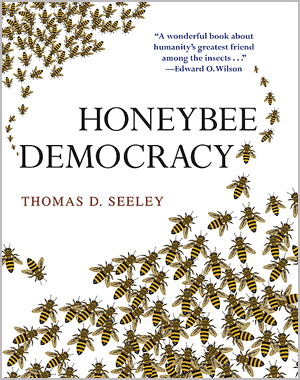
In the final chapter, Seeley suggests five lessons we could learn from bees.
• Compose a decision-making group of individuals with shared interests. Here bees have a higher stake than us: all members of a colony are related (sisters) and nobody can survive without the group.
• Minimise the leader's influence on the group. Here we humans have much to learn.
• Seek diverse solutions to the problem. Humans realised only recently that diversity is good for a group.
• Update the group's knowledge through debate. Here again, bees are superior to us, as each scout's "dances" become less effective with time, no matter how good a new site is, while stubbornness can lead humans to argue forever.
• Use quorums to gain cohesion, accuracy and speed. Impressively, bees came up with this concept long before the Greeks.
"Researchers have confirmed what most men already know: men tend to get turned on by images depicting an environment in which sperm competition is clearly at play (though few, we imagine, think of it in quite these terms). Images and videos showing one woman with multiple males are far more popular on the Internet and in commercial pornography than those depicting one male with multiple females. A quick peek at the online offerings at Adult Video Universe lists over nine hundred titles in the Gangbang genre, but only twenty-seven listed under Reverse Gangbang. You do the math. Why would the males in a species that’s been wearing the shackles of monogamy for 1.9 million years be sexually excited by scenes of groups of men ejaculating with one or two women?
As far as we know, there is no corresponding taste among women for erotica featuring multiple overweight middle-aged ladies with cheap tattoos, bad haircuts, and black socks having sex with one hot guy. Go figure.


In common with so many other émigrés, Gellner served in the war (in his case in a Czechoslovak armored unit), and he was grateful to Britain for defeating Nazism and offering him a home after the end of hostilities. Unlike many such émigrés, however, he showed no interest in acquiring the outward trappings of social success and acceptance. Instead, as Mr. Hall shows, Gellner made his watchword "cold intellectual honesty." This was matched by a strong dose of warm and passionate courage.
Gellner was by training and profession an anthropologist. He began his career by conducting fieldwork among the Berbers of Morocco, sometimes accompanied by his intrepid wife, Susan. But Gellner was really a classic polymath whose interests ranged across several disciplines at a time when it was still (just) possible to feel a mastery of more than one field of study. Gellner launched forays into philosophy, sociology, psychoanalysis and history.
The fields might have been diverse, but the method of inquiry was similar in each case: analytical rigor combined with a strict commitment to reason. Those who knew Gellner recall that this commitment could result in truly nerve-racking conversations, in which they found themselves under relentless interrogation as Gellner tried to get to the heart of a problem. There was not much small talk, and there was nowhere to hide as he chipped away at the position of his interlocutor—or, to put it another way, his opponent. As one might imagine, Gellner did not suffer fools gladly. He told the assembled doyens and divas who constituted the celebrated Cambridge History of Political Thought school, for example, that there were simply too many of them.
When he started his writing career, Gellner's targets were mainly on what was perceived to be the right side of the cultural-political spectrum: In particular, Gellner attacked the philosopher Michael Oakeshott and the intellectual historian Isaiah Berlin for their romantic traditionalism...
Gellner was at odds with Oakeshott's belief that only tradition could guarantee civilized rule and Oakeshott's related claim that the imposition of rationality would lead to fanaticism. As for Berlin, Gellner was a critic of his argument for value- pluralism, which Gellner saw as something that could be achieved only at the expense of reason. In Berlin's hands, as Gellner saw it, "the history of ideas," Mr. Hall writes, "became something of a game, in which thinkers were damned as dangerous because anti-pluralist or praised for endorsing the incommensurability of values." Gellner was particularly angered, Mr. Hall says, that "a fellow exile from the disaster zones of Europe" (Isaiah Berlin was born in Riga, Latvia, then part of the Russian Empire) could be "so infuriatingly complacent."...
Gellner's most celebrated demolition was of the literary critic Edward Said (1935-2003). When Said accused Gellner of writing about North Africa without having a command of the native language, Gellner was too modest to respond that he was in fact conversant in the language of the Berbers. He did, however, make a strong case that the whole theory of "orientalism"—Said's idea that Western interpretations and depictions of the East were designed not to understand the East but to control it—was based on erroneous assumptions about the political power of literature. The viceroys of India, he pointed out brutally, were not known for eagerly scanning the pages of late-19th-century literary magazines....
"No nation," he once wrote, "is fit to rule itself. . . . [Nations] fight each other, and they oppress their own minorities." For this reason, and others, Gellner was no Zionist; he did not believe that his Jewishness determined his identity. He was prepared to fight for Israel, he quipped, but not to live there...
As Mr. Hall demonstrates, Gellner believed that there really was a clash between "liberty and pluralism," on the one hand, and "authoritarianism and oppressiveness" on the other. In a passionate riposte to Noam Chomsky, who had accused him of ignoring Western crimes, Gellner charged that his critic had "obscured" the fact that "the survival of freedom and accountable, limited government is an enormously important value even when some of its defenders are occasionally tarnished."
He had separate reputations as scholar of Islam, theorist of nationalism, philosopher of history, and historian of ideas. He ended his career in Prague, the city in which he had grown up as a boy, though in his final years he was most interested in developments in Russia. His status as public intellectual rested on this background, that of a multilingual polymath, a modern philosophe. He was sometimes cited as one of the last great thinkers from Central Europe whose Jewish background meant a direct experience of the twentieth century's horrors....
I found him to be an exceptionally attractive human being: witty, extremely kind, modest, and blessed with a genius for creating something of a tribe around himself, cemented by an endless stream of postcards – sent, one felt, to counteract a sense of loneliness.
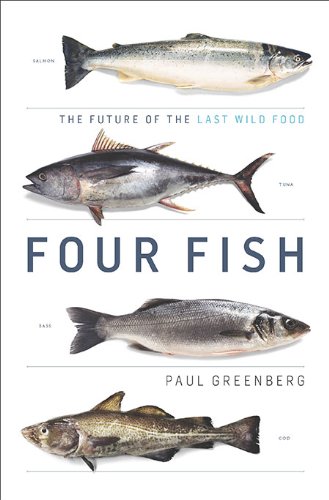
The famous story of the demise of Newfoundland’s cod is a parable of all that is wrong with industrial fishing. Cod hate cages. They don’t like being handled, are very sensitive to changes in their environment and are very hard to breed. That is the problem with fish-farming. Some fish are simply not suited to it.
Migratory tuna are also unlikely candidates for farming. Yet the high prices commanded by bluefin tuna and the demise of wild stocks have led many people to attempt to raise them in captivity in order to supply the same demand. Trying to farm a fish just because there is an established market for it is a waste of time and money, argues Mr Greenberg. Farm animals were domesticated because they were suitable to begin with, and only got more so over time. Aquaculture will only work, environmentally and economically, with the right sort of fish.


