Showing posts with label Effective Habits. Show all posts

Monday, December 5, 2011

Getting beyond the OK Plataues with 'deliberate practice'

When you want to get good at something, how you spend your time practicing is far more important than the amount of time you spend. In fact, in every domain of expertise that’s been rigorously examined, from chess to violin to basketball, studies have found that the number of years one has been doing something correlates only weakly with level of performance....

Benjamin Franklin was apparently an early practitioner of this technique. In his autobiography, he describes how he used to read essays by the great thinkers and try to reconstruct the author’s arguments according to Franklin’s own logic....

The secret to improving at a skill is to retain some degree of conscious control over it while practicing—to force oneself to stay out of autopilot....
Unlike mammographers, surgeons tend to get better with time. What makes surgeons different from mammographers, according to Ericsson, is that the outcome of most surgeries is usually immediately apparent—the patient either gets better or doesn’t—which means that surgeons are constantly receiving feedback on their performance. They’re always learning what works and what doesn’t, always getting better. This finding leads to a practical application of expertise theory: Ericsson suggests that mammographers regularly be asked to evaluate old cases for which the outcome is already known. That way they can get immediate feedback on their performance.

-Foer, Joshua (2011-03-03). Moonwalking with Einstein: The Art and Science of Remembering Everything . The Penguin Press. Kindle Edition.

Arnold Kling has an interesting discussion on the topic over at their blog.

Foer, citing Anders Ericcson and confirming with his own experience, says that what is happening at a plateau is that you are doing too much on auto-pilot. Instead, you have to jar yourself into engaging in the activity more consciously....

I wonder if there is an analogy with firms or even larger economic units. That is, a firm is bound to operate on "autopilot" to a large extent, but if it does so it will reach a plateau. And maybe firms or larger economic units sometimes have to cut back on autopilot and do worse for a while in order to escape a plateau.

Advice of the Day- We're on Borrowed Time

 Charles Wheelan commencement talk;

What it means for you, and what I’ve found to be one the great challenges of adulthood, is balancing present and future. If you want to do great things in a decade or two, you need to grind away now. You need to do things that you would prefer not to do, to spend time on things that you don’t particularly enjoy. Frankly, that’s an important part of your 20s. Sorry to be the bearer of that message. But you can’t lose sight of the fact that there are no guarantees in life. If you grind away miserably to become the CEO, no one can promise you that it will work out that way, or that the sacrifice will be worth it even if it does. On the other hand, if you spend most of your time skateboarding with friends and playing video games, I can pretty much assure you that your professional accomplishments will be limited.


You have to navigate that trade-off. On this point, I do have advice, which is to take joy in the journey, rather than building your life around how good you expect the view to be when you get to the top. Again, by the way, the happiness research is clear. Most people overstate how much they will enjoy that next promotion and the stuff it can buy—because we get used to them so quickly. By next Monday, it’s another job and a bigger TV that you still can’t find the remote control for.

Sunday, November 20, 2011

The Mind's Eye


"The Mind's Eye." Dr. Sacks focuses on creative people who have learned to compensate for potentially devastating disabilities. From the concert pianist who progressively lost the ability to recognize objects yet managed to keep performing from memory; to the writer whose stroke disturbed his ability to read but not his ability to write; to Sacks himself, who suffers from "face blindness," a condition that renders him unable to recognize people, even relatives, and, sometimes, himself. Written with his trademark insight, compassion, and humor, the book makes the obscure and arcane absolutely absorbing

Book Quote of the Day


It is no tragedy to think of the most successful people in any field as superheroes. But it is a tragedy when a belief in the judgment of experts or the marketplace rather than a belief in ourselves causes us to give up, as John Kennedy Toole did when he committed suicide after publishers repeatedly rejected his manuscript for the posthumously best-selling Confederacy of Dunces...
What I’ve learned, above all, is to keep marching forward because the best news is that since chance does play a role, one important factor in success is under our control: the number of at bats, the number of chances taken, the number of opportunities seized. For even a coin weighted toward failure will sometimes land on success. Or as the IBM pioneer Thomas Watson said, “If you want to succeed, double your failure rate.”
-Mlodinow, Leonard (2008-05-13). The Drunkard's Walk: How Randomness Rules Our Lives (p. 217). Vintage. Kindle Edition.

Friday, October 7, 2011

The Education of Millionaires

Learn to Invest in Yourself .” Bootstrapping your education involves getting on solid footing financially, and then making incremental investments in your earning power, over time, out of the cash flow—so you’re constantly learning and never going into debt. -Ellsberg, Michael (2011-09-29). The Education of Millionaires: It's Not What You Think and It's Not Too Late (Kindle Locations 2957-2959). Portfolio. Kindle Edition. Related: How to Network Your Way to World-Class Mentors

Money Ball

Sunday, September 18, 2011

Highly Recommended Podcast- Expert Prediction

The Folly of Prediction
TETLOCK: That experts thought they knew more than they knew.That there was a systematic gap between subjective probabilities that experts were assigning to possible futures and the objective likelihoods of those futures materializing.
DUBNER: Let me translate that for you. The experts were pretty awful. And you think: awful compared to what? Did they beat a monkey with a dartboard?
TETLOCK: Oh, the monkey with a dartboard comparison, that comes back to haunt me all the time. But with respect to how they did relative to, say, a baseline group of Berkeley undergraduates making predictions, they did somewhat better than that. Did they do better than an extrapolation algorithm? No, they did not. They did for the most part a little bit worse than that. How did they do relative to purely random guessing strategy? Well, they did a little bit better than that, but not as much as you might hope.
DUBNER: That “extrapolation algorithm” that Tetlock mentioned? That’s simply a computer programmed to predict “no change in current situation.” So it turned out these smart, experienced, confident experts predicted the political future about as well, if not slightly worse, than the average daily reader of The New York Times.
TETLOCK: I think the most important takeaway would be that the experts are, they think they know more than they do. They were systematically overconfident. Some experts were really massively overconfident. And we are able to identify those experts based on some of their characteristics of their belief system and their cognitive style, their thinking style
  ........
DUBNER: Hey, guess what, Sunshine? Al Gore didn’t win Florida. Didn’t become president either. Try walking that one back. So we are congenital predictors, but our predictions are often wrong. What then? How do you defend your bad predictions? I asked Philip Tetlock what all those political experts said when he showed them their results. He had already stashed their excuses in a neat taxonomy:

TETLOCK: So, if you thought that Gorbachev for example, was a fluke, you might argue, well my understanding of the Soviet political system is fundamentally right, and the Soviet Politburo, but for some quirky statistical aberration of the Soviet Politburo would have gone for a more conservative candidate. Another argument might be, well I predicted that Canada would disintegrate, that Quebec would secede from Canada, and it didn’t secede, but the secession almost did succeed because there was a fifty point one percentage vote against secession, and that’s well within the margin of sampling error.
DUBNER: Are there others you want to name?
TETLOCK: Well another popular prediction is “off on timing.” That comes up quite frequently in the financial world as well. Many very sophisticated students of finance have commented on how hard it is, saying the market can stay irrational longer than you can stay liquid, I think is George Soros’s expression. So, “off on timing” is a fairly popular belief-system defense as well. And I predicted that Canada would be gone. And you know what? It’s not gone yet. But just hold on.
DUBNER: You answered very economically when I asked you what are the characteristics of a bad predictor; you used one word, dogmatismm. What are the characteristics, then, of a good one?
TETLOCK: Capacity for constructive self-criticism.
DUBNER: How does that self-criticism come into play and actually change the course of the prediction?
TETLOCK: Well, one sign that you’re capable of constructive self-criticism is that you’re not dumbfounded by the question: What would it take to convince you you’re wrong? If you can’t answer that question you can take that as a warning sign.
DUBNER: In his study, Tetlock found that one factor was more important than any other in someone’s predictive ability: cognitive style. You know the story about the fox and the hedgehog?
TETLOCK: Isaiah Berlin tells us that the quotation comes from the Greek warrior poet Archilichus 2,500 years ago. And the rough translation was the fox knows many things but the hedgehog knows one big thing.
DUBNER: So, talk to me about what the foxes do as predictors and what the hedgehogs do as predictors.
TETLOCK: Sure. The foxes tend to have a rather eclectic, opportunistic approach to forecasting. They’re very pragmatic. A famous aphorism by Deng Xiaoping was he “didn’t care if the cat was white or black as long as it caught mice.” And I think the attitude of many foxes is they really didn’t care whether ideas came from the left or the right, they tended to deploy them rather flexibly in deriving predictions. So they often borrowed ideas across schools of thought that hedgehogs viewed as more sacrosanct. There are many subspecies of hedgehog. But what they have in common is a tendency to approach forecasting as a deductive, top-down exercise. They start off with some abstract principles, and they apply those abstract principles to messy, real-world situations, and the fit is often decidedly imperfect.
DUBNER: So foxes tend to be less dogmatic than hedgehogs, which makes them better predictors. But, if you had to guess, who do you think more likely to show up TV or in an op-ed column, the pragmatic, nuanced fox or the know-it-all hedgehog?
DUBNER: You got it!
TETLOCK: Hedgehogs, I think, are more likely to offer quotable sound bites, whereas foxes are more likely to offer rather complex, caveat-laden sound bites. They’re not sound bites anymore if they’re complex and caveat-laden.

Friday, August 5, 2011

The Art of Listening- RASA

Highly recommended talk by Julian Treasure (rating 5 out of 5);

RASA- Receive, Appreciate, Summarize, Ask

Silence
Help them to experience this possibly for the first time in their lives. Teach about it (take a look at my blog on silence for some ideas) and then work up from short shared silences - maybe one minute to start with - to longer ones. This will be very precious for them, but also very challenging. Ask them to write or share their experience of these silences, and what silence means in their lives.

Mixer
Take them to rich aural environments (start inside the school) and have them pair and log all the sound sources they hear. If you have the resources, let them experiment with multichannel sound.

Savouring
Give them a multi-day project to notice sounds and bring their three favourites in to class to share. If you have the resources (eg own a Zoom H2 digital recorder or similar) do this one small group at a time and have them record the sounds to play to all. You could do the same with sounds they dislike.

Listening positions
The most powerful of all. Pair them up and have A say what they had for breakfast while B listens from different positions (for example 1 I'm bored; 2 I want to be friends with this person; 3 I'm in a hurry; 4 what can I learn from this - please make up your own also). Have the As share their experiences at the end, then the Bs. Swap and repeat. If they get the principle that you can change reality by listening from a different place, that will be a great gift.

RASA (receive, appreciate, summarise, ask)
Practice each element by pairing up again and have listeners turn each element off and on while listening and then both people share their experience. Have them share about their general experience of being listened to at home, in school and elsewhere (especially by adults), and how it affects their own listening to others.

Saturday, January 8, 2011

Effective Habits of Political Advisors

“He was and is a bare-knuckles administrator, and by that I mean someone who not only makes the trains run on time, he makes them run ahead of time,” Mr. Lehane said. “He walked into a situation where there were disparate voices and disparate viewpoints and he quickly brought order to the house. He held people accountable. He was not afraid to make decisions.”

Now Mr. Daley — lawyer, business executive, campaign strategist, scion of Chicago’s famed political dynasty and President Obama’s new chief of staff — will bring his discipline and critical eye to the White House, which many Democrats say is in need of fresh blood. Blunt yet charming, he is a skilled negotiator and smoother around the edges than his older brother Mayor Richard M. Daley of Chicago, or his in-your-face predecessor, Rahm Emanuel.

“He’s tough, but he’s not a bully,” said Walter Mondale, the former vice president, who relied on Mr. Daley as an “adviser and a troubleshooter” when he ran for president in 1984
-Obama’s Top Aide a Tough, Decisive Negotiator

Saturday, December 18, 2010

Holbrooke the Investment Banker

Mr. Holbrooke also made millions as an investment banker on Wall Street. In the early 1980s, he was a co-founder of a Washington consulting firm, Public Strategies, which was later sold to Lehman Brothers. At various times he was a managing director of Lehman Brothers, vice chairman of Credit Suisse First Boston and a director of the American International Group.
-Richard C. Holbrooke, 1941-2010


Cliton on Holbrooke,
'But Mr. Holbrooke “understood the political implications of the psychodynamics of every conceivable permutation” when people sat down together, Mr. Clinton said.

“Here’s the thing about Milosevic,” he said Mr. Holbrooke told him at the time. “He thinks he’s meaner and tougher than anyone, and you have a reputation for being a nice person. But he is very shrewd. Once you spend an hour with him, he will know that you intend to enforce the peace, and we won’t have to go to war again.”

Be a Statistician, Be a Cynic

I have a feeling that statisticians are cynics, because you realise how much of the stuff that you are told is true in the world is actually just that month’s accident that worked out, or that month’s disaster that happened.
Appreciating how much randomness there is in everyday experience helps a lot."-Efron on statisticians

Saturday, December 4, 2010

Learn from Bees

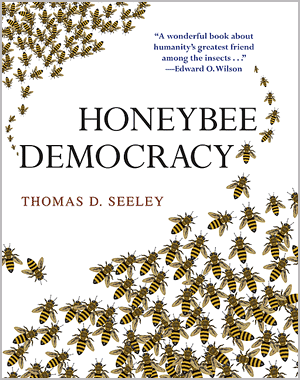
In the final chapter, Seeley suggests five lessons we could learn from bees.

• Compose a decision-making group of individuals with shared interests. Here bees have a higher stake than us: all members of a colony are related (sisters) and nobody can survive without the group.

• Minimise the leader's influence on the group. Here we humans have much to learn.

• Seek diverse solutions to the problem. Humans realised only recently that diversity is good for a group.

• Update the group's knowledge through debate. Here again, bees are superior to us, as each scout's "dances" become less effective with time, no matter how good a new site is, while stubbornness can lead humans to argue forever.

• Use quorums to gain cohesion, accuracy and speed. Impressively, bees came up with this concept long before the Greeks.

Tuesday, September 14, 2010

Memo to Self- Do you belong to the tribe of Infovore Warriors

David Warsh profiles Tyler Cowen-

Consider Cowen’s output last week on the blog – 34 items. Among them: entries n the the speech patterns of service employees (flight attendants, doctors, hookers, economics professors); the significance of layoffs in the futures market for greenhouse gases; the economic fallout from a recent earthquake in New Zealand; the nature of firms; the joys of cineplex-hopping; the magnitude of US war finance during World War II; the cost of high-speed rail; the role of securitization in the recent financial crisis; the efficacy of betting on one’s own ability to lose weight; the reason the Australian dollar is the fifth most-traded currency in the world; an arbitrage opportunity in the administration’s plans to stimulate business investment; the architecture he saw on his trip to Buffalo; a review of a new book about Adam Smith (plus a review of some other reviews); a notice of Economist correspondent Greg Ip’s The Little Book of Economics: How the Economy Works in the Real World; a lengthy rejoinder to fellow libertarian Bryan Caplan on education in poor countries around the world; news of Austan Goolsbee’s nomination as chairman of the Council of Economic Advisers; capsule reviews of the five books he is reading this week (everything from W.G. Sebald on The Natural History of Destruction and Michal Whinston’s Lectures on Antitrust to Suzanne’s Collins’ The Hunger Games, first of a trilogy for young adults); the possible benefits of not recognizing faces (a condition known as prosopagnosia, described in an article by Oliver Sacks; a plan to sell daily permits to drive 90 miles per hour on Nevada highways; the reason that a rise in imports lowers GDP; a new paper in defense of high frequency trading; and, at intervals between the entries, a couple dozen links to other interesting items that he has read....

Infovore tells the story of how Cowen came to believe that the pattern of compulsive processing of information about the economics of culture that he displays could be described as autism or its milder form, Asperger’s Syndrome. A reader had gently inquired if the habitual organizing and categorizing he displayed could be signs of the cognitive disorder. He thought not – at first. An “[U]pper class white male who all his life felt like he belonged to the dominant group in American society was suddenly faced with the suggestion that he could be part of a minority, and a very beleaguered minority at that.”

Maybe the author of this blog also belong in this category.

Assorted websites

Please Rob Me [don't post on Facebook that your houses are empty for the weeken]

Graphy Your Inbox

Monday, September 6, 2010

Bertrand Russell's Three Passions

Quote of the Day;
Three passions, simple but overwhelmingly strong, have governed my life: the longing for love, the search for knowledge, and unbearable pity for the suffering of mankind. These passions, like great winds, have blown me hither and thither, in a wayward course, over a deep ocean of anguish, reaching to the very verge of despair....

With equal passion I have sought knowledge. I have wished to understand the hearts of men. I have wished to know why the stars shine. And I have tried to apprehend the Pythagorean power by which number holds sway above the flux. A little of this, but not much, I have achieved.

via Information Processing

John Grisham, the failed tax lawyer and construction worker

Effective Habits from John Grisham-

Halfway through college, and still drifting, I decided to become a high-powered tax lawyer. The plan was sailing along until I took my first course in tax law. I was stunned by its complexity and lunacy, and I barely passed the course...

When my law office started to struggle for lack of well-paying work — indigent cases are far from lucrative — I decided to go into yet another low-paying career: in 1983, I was elected to a House seat in the Mississippi State Legislature. The salary was $8,000, which was more than I made during my first year as a lawyer. Each year from January through March I was at the State Capitol in Jackson, wasting serious time, but also listening to great storytellers. I took a lot of notes, not knowing why but feeling that, someday, those tales would come in handy...

Writing was not a childhood dream of mine. I do not recall longing to write as a student. I wasn’t sure how to start. Over the following weeks I refined my plot outline and fleshed out my characters. One night I wrote “Chapter One” at the top of the first page of a legal pad; the novel, “A Time to Kill,” was finished three years later.

The book didn’t sell, and I stuck with my day job, defending criminals, preparing wills and deeds and contracts. Still, something about writing made me spend large hours of my free time at my desk.

I had never worked so hard in my life, nor imagined that writing could be such an effort. It was more difficult than laying asphalt, and at times more frustrating than selling underwear. But it paid off. Eventually, I was able to leave the law and quit politics. Writing’s still the most difficult job I’ve ever had — but it’s worth it.

Wednesday, August 11, 2010

Exlporing one's spirituality

Advice of the Day-

For me, having a clear purpose in my life has been essential. But it was something I had to think long and hard about before I understood it. When I was a Rhodes scholar, I was in a very demanding academic program, trying to cram an extra year’s worth of work into my time at Oxford. I decided to spend an hour every night reading, thinking, and praying about why God put me on this earth. That was a very challenging commitment to keep, because every hour I spent doing that, I wasn’t studying applied econometrics. I was conflicted about whether I could really afford to take that time away from my studies, but I stuck with it—and ultimately figured out the purpose of my life.

Had I instead spent that hour each day learning the latest techniques for mastering the problems of autocorrelation in regression analysis, I would have badly misspent my life. I apply the tools of econometrics a few times a year, but I apply my knowledge of the purpose of my life every day. It’s the single most useful thing I’ve ever learned. I promise my students that if they take the time to figure out their life purpose, they’ll look back on it as the most important thing they discovered at HBS. If they don’t figure it out, they will just sail off without a rudder and get buffeted in the very rough seas of life. Clarity about their purpose will trump knowledge of activity-based costing, balanced scorecards, core competence, disruptive innovation, the four Ps, and the five forces.

Related:
The Summoned Self
In plotting out a personal and spiritual life, he applies the models and theories he developed as a strategist. He emphasizes finding the right metrics, efficiently allocating resources and thinking about marginal costs.

Clayton Christensen's Purpose-Driven Life