Showing posts with label Fitness/Games. Show all posts

Monday, December 5, 2011

Getting beyond the OK Plataues with 'deliberate practice'

When you want to get good at something, how you spend your time practicing is far more important than the amount of time you spend. In fact, in every domain of expertise that’s been rigorously examined, from chess to violin to basketball, studies have found that the number of years one has been doing something correlates only weakly with level of performance....

Benjamin Franklin was apparently an early practitioner of this technique. In his autobiography, he describes how he used to read essays by the great thinkers and try to reconstruct the author’s arguments according to Franklin’s own logic....

The secret to improving at a skill is to retain some degree of conscious control over it while practicing—to force oneself to stay out of autopilot....
Unlike mammographers, surgeons tend to get better with time. What makes surgeons different from mammographers, according to Ericsson, is that the outcome of most surgeries is usually immediately apparent—the patient either gets better or doesn’t—which means that surgeons are constantly receiving feedback on their performance. They’re always learning what works and what doesn’t, always getting better. This finding leads to a practical application of expertise theory: Ericsson suggests that mammographers regularly be asked to evaluate old cases for which the outcome is already known. That way they can get immediate feedback on their performance.

-Foer, Joshua (2011-03-03). Moonwalking with Einstein: The Art and Science of Remembering Everything . The Penguin Press. Kindle Edition.

Arnold Kling has an interesting discussion on the topic over at their blog.

Foer, citing Anders Ericcson and confirming with his own experience, says that what is happening at a plateau is that you are doing too much on auto-pilot. Instead, you have to jar yourself into engaging in the activity more consciously....

I wonder if there is an analogy with firms or even larger economic units. That is, a firm is bound to operate on "autopilot" to a large extent, but if it does so it will reach a plateau. And maybe firms or larger economic units sometimes have to cut back on autopilot and do worse for a while in order to escape a plateau.

Tuesday, September 6, 2011

Female adolescent's sexual decision-making

What Could You Do? is a theory-based interactive DVD designed to educate young women about sexually transmitted diseases (STDs) such as HIV/AIDS, chlamydia, gonorrhea, genital herpes, genital warts, trichomoniasis, and hepatitis B. The DVD also provides information about how to make less risky sexual choices and how to use condoms correctly. Watching this DVD has been shown to increase abstinence, prevent condom failure, and reduce reported STD diagnosis.

From Center for Risk Perception and Communication.

Friday, June 25, 2010

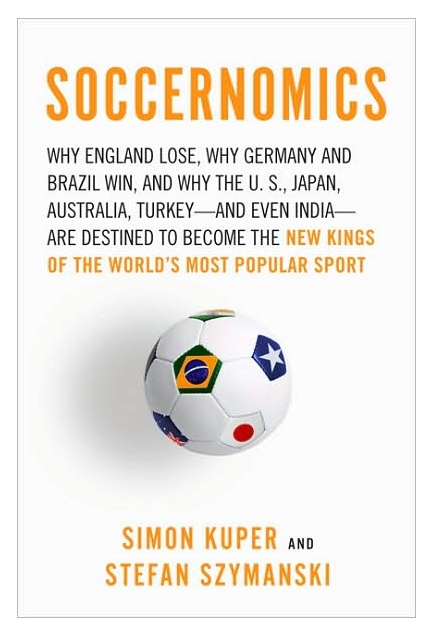
Book Cover Art- Why England Lose

Assorted Footballonomics

World Cup's African Vibe Hits the Fashion World

Grass roots soccer, African style

Ole ole ole ole: Google Wave Football Fever!

U.S.-Algeria, the Day After;
Earlier today President Obama called the U.S. Men’s World Cup Soccer team. The President congratulated them on their extraordinary victory and told them that while he was meeting with General Petraeus in the Oval Office, he could hear the rest of the West Wing erupt when Landon Donovan scored the game winner. The President then congratulated Donovan on the game-winning goal, asked Tim Howard how his ribs were feeling and asked Clint Dempsey how his lip was doing. The President wished the team good luck on Saturday and made sure they knew that the entire country was cheering them on.

The market for young soccer players


Soccer rules as a market design problem

Why England Lose

Wednesday, June 23, 2010

Assorted World Cup

Understanding Italian football part II - Furbizia
Perhaps nothing has been more influential in determining the popular perception of the Italian game than furbizia, the art of guile. For it is no overstatement to say that Italians enjoy a reputation as the dirtiest players in the game and, dryly put, as cheaters.

Investment Banks and the World Cup

Competition Description: World Cup 2010 - Take on the Quants

The Vuvuzela Externality

Soccer Done Right;
To remove these bizarre incentives, soccer should follow the ice hockey approach to penalties, after correcting for the difference in team size (six players for hockey vs. 11 for soccer) and game length (60 minutes for ice hockey vs. 90 minutes for soccer).

They think it’s all over: National identity, scoring in the last minute, and penalty shootouts


The Carbon Footprint of the 2010 World Cup

Gamesmanship and Collective Reputation

The Diving Champions of the (Football) World

While the anecdotal (and video) evidence against Italy is strong, it would be useful to have a statistical measure of diving on the basis of which international comparisons could be made. One possibility is to use data on fouls suffered. For instance, in the latest game, Italy was fouled 23 times while New Zealand suffered just 10 fouls. Either New Zealand is an unusually aggressive (or clumsy) team, or a number of the "fouls" suffered by Italy were simulated.

Back to the Future in the soccer World Cup: Chile wins 1-0 or 3-1?

Now onto more substance about the evolution of soccer: historically, the 1962 World Cup is an important turning point, since it marks the advent of modern defensive strategies in soccer. Until that World Cup, the average scoring had always exceeded 3 goals per game. In the 1962 World Cup, the goal scoring dropped significantly below 3 goals, to 2.78 goals per game, never to recover.

Defensive strategies have further taken hold. Nowadays we would be satisfied if we were witnessing ‘a mere’ 2.78 goals per game. In the seven World Cups between 1980 and 2006, the average had already dropped further to only 2.53 goals per game.