Showing posts with label Science. Show all posts

Sunday, November 20, 2011

The Mind's Eye


"The Mind's Eye." Dr. Sacks focuses on creative people who have learned to compensate for potentially devastating disabilities. From the concert pianist who progressively lost the ability to recognize objects yet managed to keep performing from memory; to the writer whose stroke disturbed his ability to read but not his ability to write; to Sacks himself, who suffers from "face blindness," a condition that renders him unable to recognize people, even relatives, and, sometimes, himself. Written with his trademark insight, compassion, and humor, the book makes the obscure and arcane absolutely absorbing

People to Watch- David Berlinski

He is the author of numerous books, including The Devil’s Delusion: Atheism and It Scientific Pretensions (Crown Forum, 2008; Basic Books, 2009), Infinite Ascent: A Short History of Mathematics for the Modern Library series at Random House (2004), The Secrets of the Vaulted Sky (Harcourt, 2003), The Advent of the Algorithm (Harcourt Brace, 2000), Newton’s Gift (Free Press, 2000), and A Tour of the Calculus (Pantheon, 1996). William F. Buckley Jr. said of The Devil’s Delusion that “Berlinski’s book is everything desirable; it is idiomatic, profound, brilliantly polemical, amusing, and of course vastly learned.

Wednesday, November 9, 2011

A book worth thinking and reading

Here's Tyler Cowen's review;
When doing the statistics, one key issue is how to measure violence. Pinker often favors “per capita” measures, but I am not so sure. I might prefer a weighted average of per capita and “absolute quantity of violence” measures. Killing six million Jews in the Holocaust is not, in my view, “half as violent” if global population is twice as high. Once you toss in the absolute measures with the per capita measures, the long-term trends are not nearly as favorable as Pinker suggests.

Tuesday, August 30, 2011

Assorted Mating Science

Ballistic penises and corkscrew vaginas – the sexual battles of ducks


Bad News for Roosters: If You Aren’t King of the Henhouse, Your Ejaculate Will Be Ejected


Kinkiness Beyond Kinky


Holy fellatio, Batman! Fruit bats use oral sex to prolong actual sex

A Mathematician tried moving a table

William Feller was a probability theorist at Princeton University. One day he and his wife wanted to move a large table from one room of their large house to another, but, try as they might, they couldn’t get it though the door. They pushed and pulled and tipped the table on its side and generally tried everything they could, but it just wouldn’t go.

Eventually, Feller went back to his desk and worked out a mathematical proof that the table would never be able to pass through the door.

While he was doing this, his wife got the table through the door
-Professor Stewart’s Hoard of Mathematical Treasures

More on Feller;
His lectures were loud and entertaining. He wrote very large on the blackboard, in a beautiful Italianate handwriting with lots of whirls. Sometimes only one huge formula appeared on the blackboard during the entire period; the rest was handwaving. His proof—insofar as one can speak of proofs—were often deficient. Nonethless, they were convincing, and the results became unforgettably clear after he had explained them. The main idea was never wrong.

He took umbrage when someone interrupted his lecturing by pointing out some glaring mistake. He became red in the face and raised his voice, often to full shouting range. It was reported that on occasion he had asked the objector to leave the classroom. The expression "proof by intimidation" was coined after Feller's lectures (by Mark Kac). During a Feller lecture, the hearer was made to feel privy to some wondrous secret, one that often vanished by magic as he walked out of the classroom at the end of the period. Like many great teachers, Feller was a bit of a con man.

I learned more from his rambling lectures than from those of anyone else at Princeton. I remember the first lecture of his I ever attended. It was also the first mathematics course I took at Princeton (a course in sophomore differential equations). The first impression he gave was one of exuberance, of great zest for living, as he rapidly wrote one formula after another on the blackboard while his white mane floated in the air. After the first lecture, I had learned two words which I had not previously heard: "lousy" and "nasty."

Sunday, August 7, 2011

What do Blind Mathematicians Study

I was surprised to learn that the majority work in geometry, supposedly the most ‘visual’ discipline, and fascinated to learn that they generally believe the experience of sight puts people at a disadvantage because it locks us into a perception-led view of space.
-Mind Hacks

Saturday, December 4, 2010

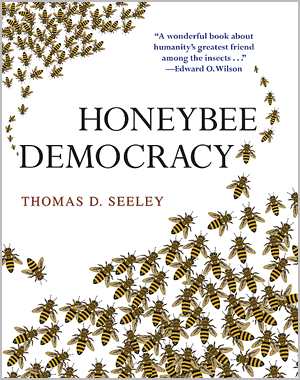
Learn from Bees

In the final chapter, Seeley suggests five lessons we could learn from bees.

• Compose a decision-making group of individuals with shared interests. Here bees have a higher stake than us: all members of a colony are related (sisters) and nobody can survive without the group.

• Minimise the leader's influence on the group. Here we humans have much to learn.

• Seek diverse solutions to the problem. Humans realised only recently that diversity is good for a group.

• Update the group's knowledge through debate. Here again, bees are superior to us, as each scout's "dances" become less effective with time, no matter how good a new site is, while stubbornness can lead humans to argue forever.

• Use quorums to gain cohesion, accuracy and speed. Impressively, bees came up with this concept long before the Greeks.

Saturday, October 16, 2010

Book Cover Art


PROOFINESS -The Dark Arts of Mathematical Deception
By Charles Seife.

Book reviews- by John Allen Paulos, STEVEN STROGATZ,

Friday, July 23, 2010

Dangerous Knowledge

In this one-off documentary, David Malone looks at four brilliant mathematicians - Georg Cantor, Ludwig Boltzmann, Kurt Gödel and Alan Turing - whose genius has profoundly affected us, but which tragically drove them insane and eventually led to them all committing suicide.

The film begins with Georg Cantor, the great mathematician whose work proved to be the foundation for much of the 20th-century mathematics. He believed he was God's messenger and was eventually driven insane trying to prove his theories of infinity.


To see a world in a grain of sand,
And a heaven in a wild flower,
Hold infinity in the palm of your hand,
And eternity in an hour.

Saturday, July 10, 2010

Art of Roughness- Mandelbrot at TED


The Mandelbrot set in a certain sense is a **** of a dream I had and an uncle of mine had since I was about 20. I was a student of mathematics, but not happy with mathematics that I was taught in France. Therefore, looking for other topics, an uncle of mine, who was a very well-known pure mathematician, wanted me to study a certain theory which was then many years old, 30 years old or something, but had in a way stopped developing. When he was young he had tried to get this theory out of a rut and he didn’t succeed, nobody succeeded. So, there was a case of two men, Julia, a teacher of mine, and Fatu, who had died, had a very good year in 1910 and then nothing was happening. My uncle was telling me, if you look at that, if you find something new, it would be a wonderful thing because I couldn’t – nobody could.

I looked at it and found it too difficult. I just could see nothing I could do. Then over the years, I put that a bit in the back of my mind until one day I read an obituary. It is an interesting story that I was motivated by an obituary, an obituary of a great man named Poincaré, and in that obituary this question was raised again. At that time, I had a computer and I had become quite an expert in the use of the computer for mathematics, for physics, and for many sciences. So, I decided, perhaps the time has come to please my uncle; 35 years later, or something. To please my uncle and do what my uncle had been pushing me to do so strongly.

But I approached this topic in a very different fashion than my uncle. My uncle was trying to think of something, a new idea, a new problem, a new way of developing the theory of Fatu and Julia. I did something else. I went to the computer and tried to experiment. I introduced a very high level of experiment in very pure mathematics. I was at IBM, I had the run of computers which then were called very big and powerful, but in fact were less powerful than a handheld machine today. But I had them and I could make the experiments. The conditions were very, very difficult, but I knew how to look at pictures. In fact, the reason I did not go into pure mathematics earlier was that I was dominated by visual. I tried to combine the visual beauty and the mathematics.

Saturday, April 24, 2010

Sex, Bombs & Burgers


The talk will focus on the main theme of the book, which is how the military, porn and food industries have been the biggest drivers of technology over the past century. The links between these three are not immediately clear, but they are all rooted in humanity's basest instincts. In essence, my book is about how the worst parts of human vice have resulted in some truly incredible achievements


It's no secret that porn is a major force on the internet - an estimated 25 per cent of all search requests are for adult content, while about one third of all websites are pornography-related. About 28,000 people are watching porn of some kind online , spending about $89 doing so, every second.
Porn, despite being commonly thought of as a negative by-product of one of our basest instincts (the need to have sex), has been a big force for innovation over the past century.

Friday, April 23, 2010

Cultural Sex Fact of the Day

Kissing as part of sexual foreplay is common in the West but virtually unknown in other parts of the world (Ford & Beach, 1965). There are some cultures where penetration was the key element to intercourse, and neither foreplay nor afterplay was recorded. Ford and Beach pointed out that physical pain and biting are sometimes permitted as part of sexual foreplay and, therefore, such behaviors are likely to be readily incorporated into the sexual repertoire

-Cultures of foreplay

Thursday, February 25, 2010

Blind Artist of the Day- John Bramblitt


John Bramblitt didn’t start painting until he lost his sight. It was a difficult time. Bramblitt was in his late 20’s and unaware that his sight was seriously degrading until he was sideswiped by an unseen car. He was also worried about having the severe epileptic seizures that had already taken their toll on his vision. And he was angry. In fact, he believes that taking up painting after losing his sight was mostly an act of defiance....

According to Bramblitt, “White feels thicker on my fingers, almost like toothpaste, and black feels slicker and thinner. To mix a gray, I’ll try to get the paint to have a feel of medium viscosity”.

-Painting By Touch

Tuesday, February 23, 2010

How Artists Think- 'they are epiphany machines'

Picaso's method;

"I have never made trials or experiments. Whenever I had something to say, I have said it in the manner in which I needed to be said...I can hardly understand the importance given to the word research in connection with modern painting. In my opinion to search means nothing in painting. To find is the thing."