Personal Kanban at the World Bank - Small Team Rapid Development
Just finished the book, Personal Kanban- Mapping Work, Navigating Life
View more presentations from Jim Benson
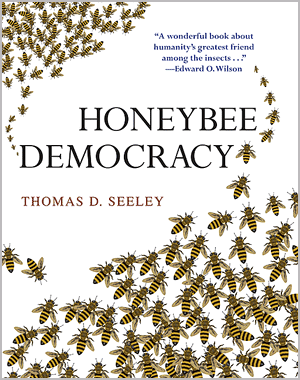
In the final chapter, Seeley suggests five lessons we could learn from bees.
• Compose a decision-making group of individuals with shared interests. Here bees have a higher stake than us: all members of a colony are related (sisters) and nobody can survive without the group.
• Minimise the leader's influence on the group. Here we humans have much to learn.
• Seek diverse solutions to the problem. Humans realised only recently that diversity is good for a group.
• Update the group's knowledge through debate. Here again, bees are superior to us, as each scout's "dances" become less effective with time, no matter how good a new site is, while stubbornness can lead humans to argue forever.
• Use quorums to gain cohesion, accuracy and speed. Impressively, bees came up with this concept long before the Greeks.

In an essay in his just-published Natural Experiments of History, Jared Diamond puts the question the way you want it to be asked – comparatively. He examines the histories of Haiti and the Dominican Republic, the two halves of the island of Hispaniola, the first place Columbus stopped in the New World. Natural Experiments is an exemplary book, short and graceful, conveying a broad swathe of the most interesting work going on today around the world in departments of economics, political science and anthropology, under the heading of comparative political economy. The story of Haiti is especially compelling.
Contents:
* Prologue: Natural Experiments of History
Jared Diamond and James A. Robinson
1. Controlled Comparison and Polynesian Cultural Evolution
Patrick V. Kirch
2. Exploding Wests: Boom and Bust in Nineteenth-Century Settler Societies
James Belich
3. Politics, Banking, and Economic Development: Evidence from New World Economies
Stephen Haber
4. Intra-Island and Inter-Island Comparisons
Jared Diamond
5. Shackled to the Past: The Causes and Consequences of Africa's Slave Trades
Nathan Nunn
6. Colonial Land Tenure, Electoral Competition, and Public Goods in India
Abhijit Banerjee and Lakshmi Iyer
7. From Ancien Régime to Capitalism: The Spread of the French Revolution as a Natural Experiment, Daron Acemoglu, Davide Cantoni, Simon Johnson, and James A. Robinson
* Afterword: Using Comparative Methods in Studies of Human History
Jared Diamond and James A. Robinson
In the south Asian context, the key contribution by Elinor Ostrom, along with other scholars (Shivakoti and Ostrom 2002) has been to provide effective empirical understanding of the performance of different types of irrigation institutional arrangements, along with a theoretical understanding of how these systems work. She demonstrated the importance of involving farmer-users in the design and management of irrigation systems for successful local resource management policies in Nepal. Work in Asia had amply demonstrated that large, centralised and essentially top-down government management systems tended to underperform, with lower rates of return on investment than systems where incentives to engineers were aligned to those of local farmer-users with their active participation (Wade 1982; Lam 1995; Ostrom 2002). Several Indian scholars have been inspired by Ostrom’s work to study issues of collective action and governance of common property resources, and to search for alternative frameworks for understanding how best to manage such resources which are often vital to the very existence of rural livelihoods in India. A large body of literature exists in India on the contributions of common property resources or CPRs as they are commonly labelled. The National Sample Survey too devoted a special round (54th round) to the de jure and de facto existence and contributions of CPRs in India, particularly in terms of their provisioning services such as fuel-wood, fodder and non-timber forest products from forests. Her work and that following hers in south Asia and elsewhere has found that institutions for collective action can emerge in rural societies characterised by inequality, prior history and poor implementation of centrally determined legal structures. Village society was often able to accept some amount of inequality, overlook prior history and agree on common norms of behaviour to solve the problems of the commons.
Several scholars from south Asia benefited from visiting the “Workshop in Political Theory and Policy Analysis”, which Ostrom established in 1973, along with her husband Vincent, a political scientist at the Indiana University Bloomington. Over time, the Workshop has turned out to be an extraordinary forum for productive deliberations from evolving associations of students and professors thereby producing a wealth of theory, empirical studies and experiments at the interface of political economy, social anthropology, economics, political science, and policy studies thereby further enriching the interdisciplinary discourse of collective action. Quite a few of the research students of Ostrom have visited Indian institutes (Institute of Economic Growth (IEG) in Delhi, being one of the prominent ones) and have worked with Indian scholars, thereby resulting in further exchanges. Ostrom herself has visited academic institutions in India a few times, the most recent visit being at the IEG in October 2008, providing the researchers the intellectual space to discuss and debate design issues in moving from models of governance of local to global commons.
Her important book that was key to her prize, Governing the Commons, 1990, has been riduculed because presumably unlike an article in the AER, it did not go through a "peer review" process
Congratulations go out to Elinor Ostrom, co-author of The Samaritan’s Dilemma: The Political Economy of Development Aid (OUP, 2005) and Oliver Williamson, author of The Mechanisms of Governance (OUP, 1999), Organization Theory: From Chester Barnard to the Present and Beyond, 2nd Edition (OUP, 1995), and The Nature of the Firm: Origins, Evolution, and Development (OUP, 1993).
To see the world more like Elinor Ostrom is to be guided less by ideology and more by the contours of the situation — to use the right institutional tool for the job. “[N]ational governments,” Ostrom tells us, “are too small to govern the global commons and too big to handle smaller scale problems.”
To understand BOTH why we don’t need police officers in some cases AND why police officers don’t follow the rules in other cases, we have to expand models of human preferences to include a contingent taste for punishing others. In reaching this conclusion, she arrived at a point similar to that reached by Avner Greif (whom the Nobel committee correctly cites.)
Democracies rarely repress their own citizens but authoritarian and totalitarian regimes do. According to one estimate (See Table 1), of the 110 million persons repressed by Marxist-Leninist regimes in the twentieth century, more than 90% were their own citizens. In democracies, less than 0.5% of victims were own citizens. It is statistics, such as these, that suggest some "generality" in Stalin's behaviour. Empirical studies also suggest that totalitarian regimes generate more "violence" than democracies (Mulligan, Gil, Sala-I-Martin, 2004)...
Our model suggests that the number of eliminations depends on the probability of correctly identifying enemies, the number of enemies, and the “threat” that the enemy poses. Although we are unable to “prove” our model based on the stylised facts of the three repressions, we can show that the model is consistent with these facts. The model makes one prediction that is consistent with Stalin’s observed behaviour that is far from intuitively obvious. A rational dictator will deliberately eliminate innocent citizens and will eliminate more innocents when enemies are difficult to identify. Stalin’s slaughter of innocents is cited by historians as a sign of his mental derangement, but in our model it is the predicted behaviour of a dictator facing a binding revolution constraint.
“The most prominent dividing line in Iraqi politics now is between the ‘powers that be’ and the ‘powers that aren’t,’ ” Sam Parker, an Arabic speaker who works for the United States Institute of Peace, a policy center in Washington, told me recently. “The ‘powers that be’ spent much of the 1980s and 1990s in open opposition to Saddam. Nearly all of these leaders spent substantial time outside of Iraq. They have well-organized parties but lack a strong social base and have an outsize degree of influence in the national and provincial governments. Because of their disproportionate dominance of the political process, they only stand to lose by any movement toward political openness.
“The ‘powers that aren’t,’ ” Parker added, “are fragmented and weak. What they want is in.”
Where does the U.S. stand? “They seem to be working hard for provincial elections,” Parker said, “which would make the system more inclusive and give the ‘powers that aren’t’ and the popular forces they represent an opportunity for a share of the power. But at the same time, the United States’ main priority appears to be buttressing the state security apparatus that belongs to the ‘powers that be.’ ”
In an ideal world the two policy imperatives would be balanced. The politics of inclusiveness would lay the foundation for the long-term stability of the country, while improvements in Maliki’s capacity to govern would lead to a state that could supplant the Hobbesian state of nature that has typified Iraq — and make it easier for the United States to reduce forces. Iraq, however, is far from an ideal world, and Maliki’s growing confidence in his own power leaves the U.S. steadily less able to shape events.
Cross-national evidence identifies a nuanced role for economic development in reducing terrorist activity. Chapters by Blomberg and Hess support policy maker conclusions that poverty drives terrorism, finding that higher incomes impede terrorist activity. Krueger and Laitin, on the other hand, find little economic foundation for terrorist origins. Why the different conclusions? Krueger and Laitin investigate the overall effects of income across all countries. In “From (No) Guns to Butter,” Blomberg and Hess argue that the effects may differ between richer and poorer countries. Looking at these two groups of countries separately, they find that higher incomes significantly reduce the threat of terrorism in poorer countries, while the opposite holds in richer countries. Pooling all countries, the two effects would cancel out. The aggregate result may then mask the important role of economic development to offset terrorist threats to poorer countries. Because of methodological and data challenges, however, we must recognize that the issue is not yet resolved.
In contrast to the lack of conclusive evidence on whether the poverty of nations is a determinant of terrorism, the evidence is more uniform that individual poverty does not make people more likely to support or participate in terrorist activity. In a survey of 6,000 Muslims from 14 countries, the poorest respondents were the least sympathetic to terrorism (Fair and Haqqani 2006). Krueger and Laitin, Laitin and Shapiro, and Llussá and Tavares, in this volume, review evidence showing that individual terrorists are neither poor nor uneducated.
The second question of concern to this volume’s contributors is whether weak governance and closed political systems foment terrorism. Results in Krueger and Laitin and Blomberg and Hess, though using substantially different approaches, coincide in finding that terrorism is more likely to originate in countries that exhibit closed political systems. Their findings lend strong support to policy maker assertions that good governance and political responsiveness to citizens are fundamental deterrents of terrorism.
Krueger and Laitin and Blomberg and Hess also agree that the economic characteristics of countries affect whether they will be the target of terrorist activity. This leads to a provocative dichotomy. The origins of terrorism seem to be in countries that suffer from political oppression; the targets are countries that enjoy economic success....
The conclusion that terrorists are driven not by personal poverty, but by the political and economic climate of the countries from which they come raises new questions. Why should the social environment be more important than individual income? Why are terrorist organizations more common in countries with difficult political climates? In their chapter, Laitin and Shapiro provide reason to believe that the answer lies in the challenges of constructing a terrorist organization. Even though terrorism is not a purely ideological phenomenon, terrorist organizations depend on ideologically motivated, educated recruits. Unlike, for example, trench warfare, terrorism requires individual initiative and the exercise of judgment. Close monitoring by terrorist leaders of their “employees” is not possible. Ideological commitment helps solve part of this contracting problem. So also does an emphasis on recruiting well-educated individuals, who are most likely to come from more prosperous families.
Laitin and Shapiro emphasize that terrorism is not simply the direct outcome of irrational behavior. Terrorism is a complex strategy to achieve economic and political goals, having roots in distinct cultural and religious differences and using ideological commitment to sharpen its organization. Their conclusion is not surprising and could extend to the role of cultural and religious factors in social conflict throughout history. The One Hundred Years War is just one example of prolonged conflict in the West in which religious motivations were intertwined with other serious economic and political differences.
Their argument explains why terrorists themselves are rarely poor and why terrorist organizations are most likely to emerge in politically closed countries. On the one hand, terrorist organization is difficult and requires individuals with substantial human capital, which is more prevalent in families rich enough to educate their children well. On the other hand, to persuade such well-educated, relatively prosperous individuals to join a terrorist organization in democratic countries is difficult: the ideological payoffs are fewer and peaceful alternatives to terrorist methods are more abundant and effective. This also explains the paradox that individual poverty is less associated with terrorist activities than national poverty. National incomes and the political responsiveness of national governments are closely related: political environments that are repressive enough to facilitate terrorist recruitment are less likely to attract substantial investment and entrepreneurial activity.
A longtime prosecutor who drew rave reviews from his supervisors was passed over for an important counterterrorism slot because his wife was active in Democratic politics, and a much-less-experienced lawyer with Republican leanings got the job, the report said.
Another prosecutor was rejected for a job in part because she was thought to be a lesbian. And a Republican lawyer got high marks at his job interview because he was found to be sufficiently conservative on the core issues of “god, guns + gays.”
The report, prepared by the Justice Department’s inspector general and its internal ethics office, centered on the misconduct of a small circle of aides to Mr. Gonzales, including Monica Goodling, a former top adviser to the attorney general, and Kyle Sampson, his former chief of staff. It also found that White House officials were actively involved in some hiring decisions.
"I want to be remembered as a fair person...nicety I don't care"