Showing posts with label Middle East. Show all posts

Saturday, June 26, 2010

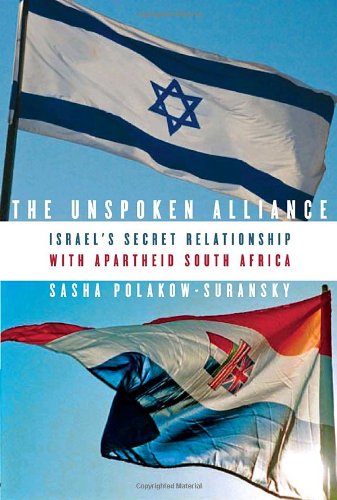
Controversial Book Cover Art- Israel and South Africa

The Unspoken Alliance: Israel's Secret Relationship with Apartheid South Africa
Author: Sasha Polakow-Suransky
But Vorster was unapologetic and proudly compared his nation to Nazi Germany: “We stand for Christian Nationalism which is an ally of National Socialism . . . you can call such an anti- democratic system a dictatorship if you like,” he declared in 1942. “In Italy it is called Fascism, in Germany National Socialism and in South Africa Christian Nationalism.” As a result of their pro-Nazi activities, Vorster and van den Bergh were declared enemies of the state and detained in a government camp.

Three decades later, as Vorster toured Yad Vashem, the Israeli government was still scouring the globe for former Nazis— extraditing or even kidnapping them in order to try them in Israeli courts. Yet Vorster, a man who was once a self- proclaimed Nazi supporter and who remained wedded to a policy of racial superiority, found himself in Jerusalem receiving full red-carpet treatment at the invitation of Israeli prime minister Yitzhak Rabin....

In April 2006, the Israeli Defense Ministry intervened to block South Africa’s release of a 1975 agreement outlining the planned military cooperation between the two countries, which is signed by Defense Ministers Shimon Peres and P. W. Botha. The Directorate of Security of the Defense Establishment (known by its Hebrew acronym Malmab) insisted that declassification of the 1975 document or any others would endanger Israel’s national security interests.

Listen to a podcast about the book

Friday, April 24, 2009

Understanding and debating Islam

One of the scholars at the Notre Dame conference whom I particularly admire is Nasr Hamid Abu Zayd, an Egyptian Muslim who argues eloquently that if the Koran is interpreted sensibly in context then it carries a strong message of social justice and women’s rights.

Dr. Abu Zayd’s own career underscores the challenges that scholars face in the Muslim world. When he declared that keeping slave girls and taxing non-Muslims were contrary to Islam, he infuriated conservative judges. An Egyptian court declared that he couldn’t be a real Muslim and thus divorced him from his wife (who, as a Muslim woman, was not eligible to be married to a non-Muslim). The couple fled to Europe, and Dr. Abu Zayd is helping the LibForAll Foundation, which promotes moderate interpretations throughout the Islamic world.

“The Islamic reformation started as early as the 19th century,” notes Dr. Abu Zayd, and, of course, it has even earlier roots as well. One important school of Koranic scholarship, Mutazilism, held 1,000 years ago that the Koran need not be interpreted literally, and even today Iranian scholars are surprisingly open to critical scholarship and interpretations.

-Islam, Virgins and Grapes

Tuesday, March 24, 2009

Political Islam 101

The Colbert ReportMon - Thurs 11:30pm / 10:30c
Juan Cole
comedycentral.com
Colbert Report Full EpisodesPolitical HumorMark Sanford


Engaging the Muslim World by Juan Cole Palgrave MacMillan, 282 pages, $26.95

Sowing Crisis: The Cold War and American Dominance in the Middle East by Rashid Khalidi, Beacon Press, 308 pages, $25.95

Dreams and Shadows: The Future of the Middle East by Robin Wright, Penguin Press, 464 pages, $26.95

Friday, February 27, 2009

More Game Theory from Middle East

In early summer 1995, a few months before his assassination, prime minister Yitzhak Rabin asked Jordan's King Hussein to approach Iraqi leader Saddam Hussein on his behalf and arrange a joint visit by Rabin and Hussein to Baghdad, according to Nigel Ashton, author of "King Hussein: A political Life" (Yale University Press).

Ashton, a senior lecturer at the London School of Economics who is close to the Hashemite royal family, was given rare access to Hussein's private archives. In his Hussein biography, Ashton writes that when handed a secret letter by a Jordanian official, "Saddam did not rule out direct contacts with Rabin," but was reluctant "to work through lower-level intermediaries." No further moves on the Israel-Iraq initiative were recorded before Rabin's murder that November....

Aston calls the Rabin request for Hussein's intervention with Saddam "a bold and remarkable secret initiative." Saddam, a bitter enemy of Israel, had launched some 40 surface-to-surface missiles at it in 1991, partly in retaliation for the 1981 bombing of the Osiraq nuclear reactor.

Rabin reasoned that opening up relations with Iraq would increase pressure on Syrian leader Hafez Assad, Saddam's enemy, to cut a peace deal with Israel. Perhaps even more importantly, Rabin saw Iran, Iraq's arch-rival, as posing a more dangerous threat to Israel, with Iran bent on a nuclear-weapons program and Iraq under an international-sanctions and monitoring regime after the 1991 war.

-British author: Rabin asked Jordan to arrange secret visit with Saddam

Saturday, January 17, 2009

What's her fault?


Being a Palestinian?

Art Therapy for Terrorism

From Jihad to Rehab;
In the first episode of Focal Point, From Jihad to Rehab, Canadian journalist Nancy Durham takes us inside a rehabilitation center in Saudi Arabia, where art therapy and religious re-education are being used to reform militant jihadists,

Monday, September 22, 2008

Egyptains find hope in Dubai

"This is Dubai: go to the mosque, it is full. Then go to the disco, it's also full!"


"Here you become more materialistic because the values are materialistic. It doesn't mean you stop praying, or being religious -- I'm still very religious -- but you focus on other things during the day, and religion becomes more personal. In Egypt the value system is totally different -- the mosque comes before the bank."-Amr el Shoubashy, 25 from Egypt

"It happened to me twice that I had a girl sitting in my car and then I kicked her out. I couldn't. When I overcame the temptation, I started going out and I was observing more than I was participating, watching guys run after women and getting wasted. It's hard to hold yourself back and choose not to do this. Because all my friends might be going out and I would have to choose to just stay home alone."
-Muhammad Darawy, 25, from Egypt

"I work in the snow all day, on a ski slope in the desert! ... People can hardly believe this back home, the snow, me skiing. Dubai is about freedom and work - these are the two main ideas here. For that, you have to give up a bit of your personal life, your home, your family, but it is worth it."-Hani Khaled, 27, Egyptian

"When I was in Egypt everything was up in the air. I had no purpose. I'd go to work, come home, change, eat and go out with my friends. Now, I have a much clearer purpose. Egypt was not good to us."-Rami Galal, 24, from Egypt

Thursday, September 11, 2008

Al Qaeda update

An in-depth examination of the evolving organism that is Al Qaeda and the US response to it- from Al Jazeera.

Part 1 / Part 2 / Part 3 / Part 4 /

Sunday, September 7, 2008

'I love her very much'- Colonel Qaddafi


In the end they met at his compound in Tripoli. After the diplomatic niceties were dealt with, Ms. Rice and Colonel Qaddafi met one on one — though with note takers and interpreters, State Department officials said — for what had been billed as a more interesting private exchange than the usual diplomatic meetings.

After all, the Libyan leader had professed his “love” for the American secretary of state. “I support my darling black African woman,” Colonel Qaddafi told the network Al Jazeera last year. “I admire and am very proud of the way she leans back and gives orders to the Arab leaders.”

He continued: “Yes, Leezza, Leezza, Leezza... I love her very much.”


*The Al Jazeera interviews Ali A. Tarhouni- an economist who has a death sentence on him by Qaddafi.

Another Saudi role model, Haifaa Mansour


“WOMEN Without Shadows” is a Saudi documentary directed by the Saudi film producer, Haifa Mansour. The documentary, which unfortunately cannot be publicly screened in the Kingdom, was shown to a select audience at the French Consulate in Jeddah. As the title indicates, the film is about Saudi women, their problems and their development over time.

Tuesday, August 19, 2008

What the future holds for Osama bin Laden's Al Qaeda


Shortly after 9/11, a Russian scientist named Dmitri Gusev proposed an explanation for the origin of the name Al Qaeda. He suggested that the terrorist organization took its name from Isaac Asimov’s famous 1950s science fiction novels known as the Foundation Trilogy. After all, he reasoned, the Arabic word “qaeda” means something like “base” or “foundation.” And the first novel in Asimov’s trilogy, Foundation, apparently was titled “al-Qaida” in an Arabic translation.

-A Beautiful Math: John Nash, Game Theory, and the Modern Quest for a Code of Nature

Friday, August 15, 2008

Nuke, Kooks and Democracy in Iran


Abbas Milani's talk will be "Nuke, Kooks and Democracy in Iran: a discussion of Iran's current political situation, and the prospects of democracy, and a resolution of the country's nuclear program." His most recent book is Tales of Two Cities: A Persian Memoir.


-Iran signed an agreement with MIT to train 100 nuclear scientists in 1976
-Khomeni stopped the program after the revolution, started it after Saddam's use of chemical weapons (and when the world ignored it).


Related;
Islamic Republic of Iran: 2008 Article IV Consultation - Staff Report

Islamic Republic of Iran: Selected Issues