






Assorted on India
14 years ago
For me, having a clear purpose in my life has been essential. But it was something I had to think long and hard about before I understood it. When I was a Rhodes scholar, I was in a very demanding academic program, trying to cram an extra year’s worth of work into my time at Oxford. I decided to spend an hour every night reading, thinking, and praying about why God put me on this earth. That was a very challenging commitment to keep, because every hour I spent doing that, I wasn’t studying applied econometrics. I was conflicted about whether I could really afford to take that time away from my studies, but I stuck with it—and ultimately figured out the purpose of my life.
Had I instead spent that hour each day learning the latest techniques for mastering the problems of autocorrelation in regression analysis, I would have badly misspent my life. I apply the tools of econometrics a few times a year, but I apply my knowledge of the purpose of my life every day. It’s the single most useful thing I’ve ever learned. I promise my students that if they take the time to figure out their life purpose, they’ll look back on it as the most important thing they discovered at HBS. If they don’t figure it out, they will just sail off without a rudder and get buffeted in the very rough seas of life. Clarity about their purpose will trump knowledge of activity-based costing, balanced scorecards, core competence, disruptive innovation, the four Ps, and the five forces.
In plotting out a personal and spiritual life, he applies the models and theories he developed as a strategist. He emphasizes finding the right metrics, efficiently allocating resources and thinking about marginal costs.
-Learning a Language From an Expert, on the WebMyLanguageExchange.com just maintains lists of people who know certain languages and want to learn others. Anyone can search the database, but only gold members, who pay $24 a year, can send e-mail easily to others.
Each person sets up a profile and includes a short description of age, location and what he or she would like to talk about. There is a big demand to practice English, and I found many possible pen pals.
Marie, 40, was born in Spain but lives in France near the Bordeaux region. She wants to improve her English and “perhaps find a job in sales export.” Serge, a Parisian who is retired, studies genealogy and wants to improve his English, Spanish and Swedish.
MyLanguageExchange.com claims it has more than 1.5 million members studying 115 languages.
I find the right partner through what are essentially classified ads. If I wanted to study Luxembourgish, the Germanic tongue of Luxembourg, there were 11 people looking to study English. There are 32 willing people who are fluent in Tswana, a Bantu language generally spoken around Southern Africa, mainly in Botswana. An e-mail or two is all it takes to find a study partner.
Maria, one of 113 people ready to help with Uyghur, which is spoken in western China, says she is also fluent in Mandarin but wants to practice Russian, Hindi and English. It is a big database.

In common with so many other émigrés, Gellner served in the war (in his case in a Czechoslovak armored unit), and he was grateful to Britain for defeating Nazism and offering him a home after the end of hostilities. Unlike many such émigrés, however, he showed no interest in acquiring the outward trappings of social success and acceptance. Instead, as Mr. Hall shows, Gellner made his watchword "cold intellectual honesty." This was matched by a strong dose of warm and passionate courage.
Gellner was by training and profession an anthropologist. He began his career by conducting fieldwork among the Berbers of Morocco, sometimes accompanied by his intrepid wife, Susan. But Gellner was really a classic polymath whose interests ranged across several disciplines at a time when it was still (just) possible to feel a mastery of more than one field of study. Gellner launched forays into philosophy, sociology, psychoanalysis and history.
The fields might have been diverse, but the method of inquiry was similar in each case: analytical rigor combined with a strict commitment to reason. Those who knew Gellner recall that this commitment could result in truly nerve-racking conversations, in which they found themselves under relentless interrogation as Gellner tried to get to the heart of a problem. There was not much small talk, and there was nowhere to hide as he chipped away at the position of his interlocutor—or, to put it another way, his opponent. As one might imagine, Gellner did not suffer fools gladly. He told the assembled doyens and divas who constituted the celebrated Cambridge History of Political Thought school, for example, that there were simply too many of them.
When he started his writing career, Gellner's targets were mainly on what was perceived to be the right side of the cultural-political spectrum: In particular, Gellner attacked the philosopher Michael Oakeshott and the intellectual historian Isaiah Berlin for their romantic traditionalism...
Gellner was at odds with Oakeshott's belief that only tradition could guarantee civilized rule and Oakeshott's related claim that the imposition of rationality would lead to fanaticism. As for Berlin, Gellner was a critic of his argument for value- pluralism, which Gellner saw as something that could be achieved only at the expense of reason. In Berlin's hands, as Gellner saw it, "the history of ideas," Mr. Hall writes, "became something of a game, in which thinkers were damned as dangerous because anti-pluralist or praised for endorsing the incommensurability of values." Gellner was particularly angered, Mr. Hall says, that "a fellow exile from the disaster zones of Europe" (Isaiah Berlin was born in Riga, Latvia, then part of the Russian Empire) could be "so infuriatingly complacent."...
Gellner's most celebrated demolition was of the literary critic Edward Said (1935-2003). When Said accused Gellner of writing about North Africa without having a command of the native language, Gellner was too modest to respond that he was in fact conversant in the language of the Berbers. He did, however, make a strong case that the whole theory of "orientalism"—Said's idea that Western interpretations and depictions of the East were designed not to understand the East but to control it—was based on erroneous assumptions about the political power of literature. The viceroys of India, he pointed out brutally, were not known for eagerly scanning the pages of late-19th-century literary magazines....
"No nation," he once wrote, "is fit to rule itself. . . . [Nations] fight each other, and they oppress their own minorities." For this reason, and others, Gellner was no Zionist; he did not believe that his Jewishness determined his identity. He was prepared to fight for Israel, he quipped, but not to live there...
As Mr. Hall demonstrates, Gellner believed that there really was a clash between "liberty and pluralism," on the one hand, and "authoritarianism and oppressiveness" on the other. In a passionate riposte to Noam Chomsky, who had accused him of ignoring Western crimes, Gellner charged that his critic had "obscured" the fact that "the survival of freedom and accountable, limited government is an enormously important value even when some of its defenders are occasionally tarnished."
He had separate reputations as scholar of Islam, theorist of nationalism, philosopher of history, and historian of ideas. He ended his career in Prague, the city in which he had grown up as a boy, though in his final years he was most interested in developments in Russia. His status as public intellectual rested on this background, that of a multilingual polymath, a modern philosophe. He was sometimes cited as one of the last great thinkers from Central Europe whose Jewish background meant a direct experience of the twentieth century's horrors....
I found him to be an exceptionally attractive human being: witty, extremely kind, modest, and blessed with a genius for creating something of a tribe around himself, cemented by an endless stream of postcards – sent, one felt, to counteract a sense of loneliness.
“Life is short, art is long, opportunity fleeting, experiment treacherous, judgment difficult.”
In this one-off documentary, David Malone looks at four brilliant mathematicians - Georg Cantor, Ludwig Boltzmann, Kurt Gödel and Alan Turing - whose genius has profoundly affected us, but which tragically drove them insane and eventually led to them all committing suicide.
The film begins with Georg Cantor, the great mathematician whose work proved to be the foundation for much of the 20th-century mathematics. He believed he was God's messenger and was eventually driven insane trying to prove his theories of infinity.
To see a world in a grain of sand,
And a heaven in a wild flower,
Hold infinity in the palm of your hand,
And eternity in an hour.
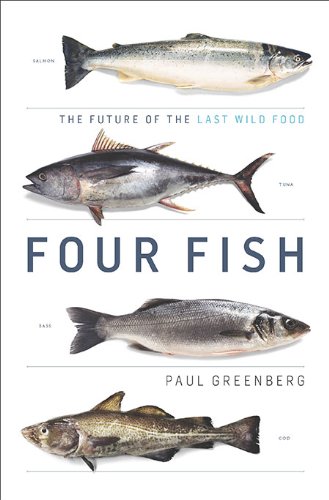
The famous story of the demise of Newfoundland’s cod is a parable of all that is wrong with industrial fishing. Cod hate cages. They don’t like being handled, are very sensitive to changes in their environment and are very hard to breed. That is the problem with fish-farming. Some fish are simply not suited to it.
Migratory tuna are also unlikely candidates for farming. Yet the high prices commanded by bluefin tuna and the demise of wild stocks have led many people to attempt to raise them in captivity in order to supply the same demand. Trying to farm a fish just because there is an established market for it is a waste of time and money, argues Mr Greenberg. Farm animals were domesticated because they were suitable to begin with, and only got more so over time. Aquaculture will only work, environmentally and economically, with the right sort of fish.
Now that it's official—Facebook has half a billion users—I feel at last that I have a reply for my wife. She (60) has been mocking me for having a Facebook account at my age (59). For the past year my mendacious excuse has been that I joined to keep a weather eye on what my children (30 and 28) are up to. But now I can tell her that half a billion members can't all be wrong. Facebook is not just a useful tool but oddly comforting.
In the early days Mr Zuckerberg comes across as a mixture of programming prodigy and business neophyte (his initial business cards bear the memorable phrase “I’m CEO…bitch!”). But his leadership instincts are commendably sharp. By surrounding himself with experienced advisers, he manages to steer Facebook clear of hurdles that threaten to derail its growth and soon finds himself the object of fawning attention from companies and venture capitalists drooling over the firm’s fast-growing franchise. The pressure on the fledgling entrepreneur is intense. In one scene Mr Zuckerberg retreats to the bathroom of a swank Silicon Valley restaurant and bursts into tears during a stressful negotiation over funding.-Review of the book from The Economist
But behind the tears is toughness. Facebook’s boss turns down several Croesus-like offers to buy the company in spite of intense lobbying by fellow shareholders who think he should sell. And he pursues his vision of making the world a more open and connected place with single-minded determination. Some of the most interesting passages in “The Facebook Effect” describe how Mr Zuckerberg’s missionary zeal makes him ambivalent towards initiatives that would mint money for Facebook but fail to advance its agenda of “radical transparency”.
It is this zeal—and the company’s habit of suddenly revealing more of a user’s information in unexpected ways—that has repeatedly got it into hot water. Here Mr Kirkpatrick puts his finger on the contradiction between Mr Zuckerberg’s professed belief in the importance of protecting people’s privacy and his deep-seated conviction that people are rapidly losing interest in keeping their personal data hidden.
Life is all about the grey area. When I was growing up I wasn't sure where I belonged in the world of religion. The way religion was taught in the Arab world was always in absolutes. While I didn't know much when I was young, I knew that I could not live in a black or white, either-or world. This was made most clear through a sermon delivered by a young imam who was studying for his doctorate at the Harvard Divinity School.-Dr. Naif Al-Mutawa
Speaking to a group of Muslim students, Imam Talal Eid said, "If you ask me whether charging interest is haram (forbidden) in Islam, I would say yes and I would quote chapter and verse from the Qur'an for you."
After a long pause, he went on to say, "But if I didn't pay for my car with an installment loan, I wouldn't be able to come here to talk to you about Islam."
With that simple, expressive example between the absolute and the relative, the imam carved out a place of tolerance and compromise for me. He made it safe for me to be the judge of my own actions, to set my own course, to walk to the beat of my own drum. He made it safe to make my own rules using the lessons I learned with the heart and mind that God gave me. No one could force me to walk away from my duty as a Muslim, by insisting there was only one way to live my life and practice my faith.

I grew up in a part of the world where George Orwell's Animal Farm was banned. It was also banned in the former Soviet Union. The Kremlin banned it because as a totalitarian regime, it did not want democratic messages to be spread within its borders. The censors in the USSR chose to go beneath the surface of the allegory, understand the message in the book and ban it accordingly. In my neck of the desert, it was banned because there was a pig on the cover. Go figure.- Dr. Naif A. Al-Mutawa
The Holy Qur'an was revealed in an Arabia that was alive with the richness of Jahiliya (pre-Islamic) period poetry. The miracle of the Qur'an was not only in its message, but also in the complexity of the syntax used to communicate that message. Its prose is unmatched in the history of the Arabic language. It is an absolute shame that the Qur'an continues to be held hostage by those who favour the idolatry of words over the depth of their meaning and the elasticity of the human intellect.

After Howard Engel (author of 12 best-selling mystery novels featuring his beloved detective, Benny Cooperman) realized that he couldn't make out the printed word that summer morning in 2001, he took himself off to the Emergency Room of his local hospital where the doctors diagnosed his condition as "alexia sine agraphia" (which came about owing to a stroke that he had suffered). A person with alexia can write without difficulty but will no longer be able to read what he writes. This was almost impossible for Engels to accept, after all, he had always been a reader, his brain was hard-wired to read "...I could no more stop reading than I could stop my heart. Reading was bone and marrow, lymph and blood to me", besides, he made his living writing, if he couldn't read what he wrote, how would he make his living?
“I am Dutch,” Cruyff said last week to El Periódico in Spain, where he lives. “But I will always defend the football Spain play.”-A Dutch Great Helped Transform Spain’s Game
That is an easy transition for him because the soccer Spain plays is downright Dutch, and it can trace its roots to Cruyff. At the height of his playing career in 1973, Cruyff joined Barcelona and played there five years, winning the Spanish championship and the Spanish cup. He had even greater success when he coached Barcelona from 1988 to 1996, winning four league titles and the 1992 European Cup.
He also helped establish methods used at the club’s acclaimed youth academy, La Masia, where a third of the current Spanish team learned a style of play that was neither Spanish nor Dutch, but which is internationally appealing and very effective....
The Spanish style is based on the Dutch system of “total football,” developed at the Amsterdam club Ajax, where Cruyff learned the game. It requires every player on the field to be a playmaker, as a dribbler or passer, depending on what the situation requires.
Open sections of the field were not gaps to be traversed with long passes or frantic runs forward; rather, they were areas to mount an organized, well-fortified attack with keen passing and combination play. That is the sort of play Spain has used here to dominate possession on its way to the final after losing to Switzerland, 1-0, in its opening match.
“I think Spain is the country playing the best football in the past few years,” Netherlands Coach Bert van Marwijk said Saturday. “I’ve been the coach of the national squad for two years now, and during that time, it has crossed my mind that I would love to play Spain, and now it is happening.”
He added: “Both teams have their own style, and they do resemble each other. Right now, Spain has executed better.”
The Mandelbrot set in a certain sense is a **** of a dream I had and an uncle of mine had since I was about 20. I was a student of mathematics, but not happy with mathematics that I was taught in France. Therefore, looking for other topics, an uncle of mine, who was a very well-known pure mathematician, wanted me to study a certain theory which was then many years old, 30 years old or something, but had in a way stopped developing. When he was young he had tried to get this theory out of a rut and he didn’t succeed, nobody succeeded. So, there was a case of two men, Julia, a teacher of mine, and Fatu, who had died, had a very good year in 1910 and then nothing was happening. My uncle was telling me, if you look at that, if you find something new, it would be a wonderful thing because I couldn’t – nobody could.
I looked at it and found it too difficult. I just could see nothing I could do. Then over the years, I put that a bit in the back of my mind until one day I read an obituary. It is an interesting story that I was motivated by an obituary, an obituary of a great man named Poincaré, and in that obituary this question was raised again. At that time, I had a computer and I had become quite an expert in the use of the computer for mathematics, for physics, and for many sciences. So, I decided, perhaps the time has come to please my uncle; 35 years later, or something. To please my uncle and do what my uncle had been pushing me to do so strongly.
But I approached this topic in a very different fashion than my uncle. My uncle was trying to think of something, a new idea, a new problem, a new way of developing the theory of Fatu and Julia. I did something else. I went to the computer and tried to experiment. I introduced a very high level of experiment in very pure mathematics. I was at IBM, I had the run of computers which then were called very big and powerful, but in fact were less powerful than a handheld machine today. But I had them and I could make the experiments. The conditions were very, very difficult, but I knew how to look at pictures. In fact, the reason I did not go into pure mathematics earlier was that I was dominated by visual. I tried to combine the visual beauty and the mathematics.

-Use two balls. Having two balls in play will increase the number of shots, and spread out the defense. The balls can be color coded, with one ball being worth two points and the other ball one point.
-Add a goal tunnel. Have a corrugated metal tube that runs into the goal from beyond the goalie area. If someone can kick the ball into the tube, it is an automatic goal, since the goalie cannot defend it. New and entertaining strategies can be added with this feature. For example, players can be "tunneled" by being slammed against the sharp metal edges of the tube, thereby increasing the physical component, and with it, the entertainment value of the sport.
Almost 50% of the children previously diagnosed with autism are found to be suffering from some degree of brain seizure activity that is undetectable to the eye...In the cases where these seizures are the cause of the symptoms, once the seizures have been detected and treated, the level and speed of recovery in the children has been remarkable.-Please Help Avoid Misdiagnosing Development Disorders
As a public service, therefore, I’m offering a handy clip-’n’-save guide to the social networking services you’re most likely to hear about at this summer’s barbecues.
Facebook- This is the biggest social networking service, with almost 500 million members — 22 percent of everyone on the Internet — and it’s growing by 5 percent a month. Similar to Facebook- Myspace, Bebo, Orkut
LINKEDIN - It’s Facebook for the professional set
TWITTER -This is the service that lets you send tweets — er, brief, 140-character updates that feel a lot like text messages. Using search.twitter.com, you can find out what the world is saying about you, your company or any topic that interests you. Similaar: Google Buzz,FriendFeed,
Others: FOURSQUARE, Gowalla, Loopt, Brightkite, YELP, OpenTable,UrbanSpoon,
First question: Is there a relationship between the quality of generalship and the quality of a memoir? I think there is, if only because the more adept and successful generals have more interesting stories to tell. In this sense, war memoirs invert Tolstoy's famous observation that all happy families are alike. All successful generals are different, but all defeated generals are essentially similar-or at least their memoirs are. Two of the best generals' memoirs of World War II, I think, are Slim's and Eisenhower's. Likewise, the best Civil War memoir is Grant's. By contrast, what would Fredendall or Short have to say?
Clark wasn't a failure, but he was mediocre. So his memoir is worse than his record would indicate.


After much hand-wringing, he decided to return to the United States to attend Yale, which overlooked his threadbare high school transcript. He considered majoring in Russian until Jeremy Bulow, a classmate who is now an economics professor at Stanford, began evangelizing about economics.
Mr. Rogoff took an econometrics course, reveling in its precision and rigor, and went on to focus on comparative economic systems. He interrupted a brief stint in a graduate program in economics at the Massachusetts Institute of Technology to prepare for the world chess championships, which were held only every three years.
After becoming an “international grandmaster,” the highest title awarded in chess, when he was 25, he decided to quit chess entirely and to return to M.I.T. He did so because he had snared the grandmaster title and because he realized that he would probably never be ranked No. 1.
He says it took him a long time to get over the game, and the euphoric, almost omnipotent highs of his past victories.
“To this day I get letters, maybe every two years, from top players asking me: ‘How do I quit? I want to quit like you did, and I can’t figure out how to do it,’ ” he says. “I tell them that it’s hard to go from being at the top of a field, because you really feel that way when you’re playing chess and winning, to being at the bottom — and they need to prepare themselves for that.”
He returned to M.I.T., rushed through what he acknowledges was a mediocre doctoral dissertation, and then became a researcher at the Federal Reserve — where he said he had good role models who taught him how to be, at last, “professional” and “serious.” ...
And, unlike Mr. Rogoff, she has never been hired by an Ivy League school. But measured by how often her work is cited by colleagues and others, this woman whom several colleagues describe as a “firecracker” is, by a long shot, the most influential female economist in the world.
Like Mr. Rogoff, she took a circuitous route to her present position.
Born in Havana as Carmen Castellanos, she is quick-witted and favors bright, boldly printed blouses and blazers. As a girl, she memorized the lore of pirates and their trade routes, which she says was her first exposure to the idea that economic fortunes — and state revenue in particular — “can suddenly disappear without warning.”
She also lived with more personal financial and social instability. After her family fled Havana for the United States with just three suitcases when she was 10, her father traded a comfortable living as an accountant for long, less lucrative hours as a carpenter. Her mother, who had never worked outside the home before, became a seamstress.
“Most kids don’t grow up with that kind of real economic shock,” she says. “But I learned the value of scarcity, and even the sort of tensions between East and West. And at a very early age that had an imprint on me.”
With a passion for art and literature — even today, her academic papers pun on the writings of Gabriel García Márquez — she enrolled in a two-year college in Miami, intending to study fashion merchandising. Then, on a whim, she took an economics course and got hooked.
When she went to Florida International University to study economics, she met Peter Montiel, an M.I.T. graduate who was teaching there. Recognizing her talent, he helped her apply to a top-tier graduate program in economics, at Columbia University.
At Columbia, she met her future husband, Vincent Reinhart, who is now an occasional co-author with her. They married while in graduate school, and she quit school before writing her dissertation to try to make some money on Wall Street.
“We were newlyweds, and neither of us had a penny to our name,” she says. She left school so that they “could have nice things and a house, the kind of things I imagined a family should have.”
She spent a few years at Bear Stearns, including one as chief economist, before deciding to finish her graduate work at Columbia and return to her true love: data mining. “I have a talent for rounding up data like cattle, all over the plain,” she says.
Be grateful. Yes, I often hear from people that they are tired of being admonished to be grateful. It’s no wonder there is a sort of societal “gratitude fatigue” given how much press this concept have received in self-help literature over the past ten years or so. However, there’s a good reason why this advice persists not just from modern authors, but also from the earliest philosophers and religious writers. It works. Gratitude for what one has in their life is a critical part of contentment. Without gratitude, contentment will always be elusive. The results of the first major study on the efficacy of gratitude for cultivating contentment and happiness is presented in a recent book, Thanks! How Practicing Gratitude Can Make You Happier, by Robert A. Emmons. He is a big proponent of gratitude journaling, recommending that writing out a few items for which we’re grateful every day will help instill a “grateful heart” and contribute to us “loving what we have.”

But Vorster was unapologetic and proudly compared his nation to Nazi Germany: “We stand for Christian Nationalism which is an ally of National Socialism . . . you can call such an anti- democratic system a dictatorship if you like,” he declared in 1942. “In Italy it is called Fascism, in Germany National Socialism and in South Africa Christian Nationalism.” As a result of their pro-Nazi activities, Vorster and van den Bergh were declared enemies of the state and detained in a government camp.
Three decades later, as Vorster toured Yad Vashem, the Israeli government was still scouring the globe for former Nazis— extraditing or even kidnapping them in order to try them in Israeli courts. Yet Vorster, a man who was once a self- proclaimed Nazi supporter and who remained wedded to a policy of racial superiority, found himself in Jerusalem receiving full red-carpet treatment at the invitation of Israeli prime minister Yitzhak Rabin....
In April 2006, the Israeli Defense Ministry intervened to block South Africa’s release of a 1975 agreement outlining the planned military cooperation between the two countries, which is signed by Defense Ministers Shimon Peres and P. W. Botha. The Directorate of Security of the Defense Establishment (known by its Hebrew acronym Malmab) insisted that declassification of the 1975 document or any others would endanger Israel’s national security interests.
Earlier today President Obama called the U.S. Men’s World Cup Soccer team. The President congratulated them on their extraordinary victory and told them that while he was meeting with General Petraeus in the Oval Office, he could hear the rest of the West Wing erupt when Landon Donovan scored the game winner. The President then congratulated Donovan on the game-winning goal, asked Tim Howard how his ribs were feeling and asked Clint Dempsey how his lip was doing. The President wished the team good luck on Saturday and made sure they knew that the entire country was cheering them on.

Perhaps nothing has been more influential in determining the popular perception of the Italian game than furbizia, the art of guile. For it is no overstatement to say that Italians enjoy a reputation as the dirtiest players in the game and, dryly put, as cheaters.
To remove these bizarre incentives, soccer should follow the ice hockey approach to penalties, after correcting for the difference in team size (six players for hockey vs. 11 for soccer) and game length (60 minutes for ice hockey vs. 90 minutes for soccer).
While the anecdotal (and video) evidence against Italy is strong, it would be useful to have a statistical measure of diving on the basis of which international comparisons could be made. One possibility is to use data on fouls suffered. For instance, in the latest game, Italy was fouled 23 times while New Zealand suffered just 10 fouls. Either New Zealand is an unusually aggressive (or clumsy) team, or a number of the "fouls" suffered by Italy were simulated.
Now onto more substance about the evolution of soccer: historically, the 1962 World Cup is an important turning point, since it marks the advent of modern defensive strategies in soccer. Until that World Cup, the average scoring had always exceeded 3 goals per game. In the 1962 World Cup, the goal scoring dropped significantly below 3 goals, to 2.78 goals per game, never to recover.
Defensive strategies have further taken hold. Nowadays we would be satisfied if we were witnessing ‘a mere’ 2.78 goals per game. In the seven World Cups between 1980 and 2006, the average had already dropped further to only 2.53 goals per game.

"The BP oil spill in the Gulf of Mexico, one of only two known Atlantic bluefin spawning grounds, has only intensified the crisis. By some estimates, there may be only 9,000 of the most ecologically vital megabreeders left in the fish’s North American stock, enough for the entire population of New York to have a final bite (or two) of high-grade otoro sushi. The Mediterranean stock of bluefin, historically a larger population than the North American one, has declined drastically as well. Indeed, most Mediterranean bluefin fishing consists of netting or “seining” young wild fish for “outgrowing” on tuna “ranches.” Which was why the Greenpeace craft had just deployed off Malta: a French fishing boat was about to legally catch an entire school of tuna, many of them undoubtedly juveniles."-Tuna’s End
-Turks Put Twist in Racy SoapsIf this seems like a triumph of Western values by proxy, the Muslim context remains the crucial bridge. “Ultimately, it’s all about local culture,” said Irfan Sahin, the chief executive of Dogan TV Holding, Turkey’s largest media company, which owns Kanal D. “People respond to what’s familiar.” By which he meant that regionalism, not globalism, sells, as demonstrated by the finale of “Noor” last summer on MBC, the Saudi-owned, Dubai-based, pan-Arab network that bought rebroadcast rights from Mr. Sahin. A record 85 million Arab viewers tuned in.
That said, during the last 20 years or so Turkey has ingested so much American culture that it has experienced a sexual revolution that most of the Arab world hasn’t, which accounts for why “Noor” triumphed in the Middle East but was considered too tame for most Turks. Even Mr. Sahin wonders, by contrast, whether the racier “Ask-i Memnu,” a smash with young Turks, threatens to offend Arabs unless it is heavily edited.
“You have to understand that there are people still living even in this city who say they only learned how to kiss or learned there is kissing involved in lovemaking by watching ‘Noor,’ explained Sengul Ozerkan, a professor of television here who conducts surveys of such things. “So you can imagine why the impact of that show was so great in the Arab world and why ‘Ask-i Memnu’ may be too much.
“But then, Turkey always acts like a kind of intermediary between the West and the Middle East,” she added.

On five Saturdays this month and next, Mr. Barman, Mr. Hinojosa and 54 other artists are attending a class paid for by the City of New York that is intended to help them turn their creative works into money.-Creative Types, Learning to Be Business-Minded
“Does everyone have Excel?,” Peter Cobb, a lawyer and administrator at the New York Foundation for the Arts, which runs the program, asked the class last Saturday. “For next week, your assignment is to make a list of all your expenses for 2009.”
The sighs and complaints that followed were proof of the challenging task Mr. Cobb and his colleagues have taken on: trying to teach people who like to color outside the lines about drawing up business plans, budgeting and making a sales pitch...
“Artists are not taught to plan,” said Jackie Battenfield, a painter and the author of “The Artist’s Guide: How to Make a Living Doing What You Love.” Too often, she said, they’re “going in circles, and that’s very demoralizing.”
This is the first time the city has financed such a program, though others, like one at the Bronx Museum called Artists in the Marketplace, have long strived to help artists manage their careers.


People that are put in a condition of feeling out of control are more likely to see something in this, which is allegedly patternless. In other words, the propensity to find these patterns goes up when there's a lack of control. For example, baseball players are notoriously superstitious when they're batting, but not so much when they're fielding. Because fielders are successful 90 to 95 percent of the time. The best batters fail seven out of 10 times. So their superstitions, their patternicities, are all associated with feelings of lack of control and so forth.-The pattern behind self-deception


