Showing posts with label Behavioral Economics. Show all posts

Friday, August 26, 2011

The Age of Erotic Capital? Legal Protection for the Ugly?

over a lifetime and assuming today’s mean wages, a handsome worker in America might on average make $230,000 more than a very plain one.
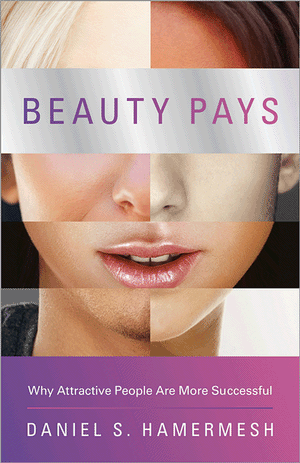
The Economist reviews three books on beauty;
Beauty Pays: Why Attractive People are More Successful. By Daniel Hamermesh
The Beauty Bias: The Injustice of Appearance in Life and Law. By Deborah Rhode
Honey Money: The Power of Erotic Capital. By Catherine Hakim

We of course recommend Hamermesh!
Chapter 8. Legal Protection for the Ugly
Fairness and Public Policy
What Kinds of Protection Are Possible?
How Have Existing Policies Been Used?
Is It Possible to Protect the Ugly?
What Justifies Protecting the Ugly?
What Justifies Not Protecting the Ugly?
What Is an Appropriate Policy?
Protecting the Ugly in the Near Future

Saturday, December 18, 2010

Are you sponge worthy?

In an episode of the television sitcom Seinfeld, Elaine Benes’s favorite contraceptive sponge is taken off the market. She scours pharmacies to stock up, but her supply is now finite, so she must “reevaluate her whole screening process.” Every time she dates a new man, she has to consider whether he is “spongeworthy.”

When Elaine uses a sponge, Dixit says, she is forfeiting the option to have it available when an even better man comes along. He developed a mathematical model to quantify this concept of spongeworthiness many years ago, but kept quiet because it seemed inappropriate at the time. “I hope that my advanced age now exempts me from the constraints of political correctness,” Dixit wrote after retiring from teaching earlier this year

Sunday, March 7, 2010

Schelling Quote- The Very Basics of Game Theory

"If I go downstairs to investigate a noise at night, with a gun in my hand, and find myself face to face with a burglar who has a gun in his hand, there is a danger of an outcome that neither of us desires. Even if he prefers to just leave quietly, and I wish him to, there is danger that he may think I want to shoot, and shoot first."


via David Henderson

The Lesson: 'in thinking through various actions you might take to have an effect on B, ask yourself how you would respond to such actions if you were B. In other words, put yourself in the other person's shoes, not to get a touchy, feely, we're-all-in-this together Kumbaya moment, but to come up with your most-realistic analysis'

Tuesday, March 2, 2010

Daniel Kahneman on Happiness


Daniel Kahneman reveals how our "experiencing selves" and our "remembering selves" perceive happiness differently

Saturday, August 30, 2008

How to dog-train your kids

One of the best TED talks;


The Anti-Cesar Millan
Sirius Dog Training, as Dunbar called it, showed proven positive results from early off-leash training. His classes, and the resulting video, were embraced by trainers and owners alike. Many say Sirius spurred the demise of punitive, punishment-based training that was the vogue after World War II. In 1993, Dunbar founded the Association of Pet Dog Trainers whose mission is to promote better training through education.

The return to dominance training such as Millan's, Dunbar says, is a disservice to dogs more than anything else. Though Millan gets results, Dunbar notes that most people don't have Millan's strength or skill, and even fewer keep dozens of dogs. "I teach methods that a supervised 4-year-old can use," Dunbar says. Having been called as a witness in high-profile Bay Area bite trials -- he was one of a team who evaluated one of the dogs involved in the deadly attack on Diane Whipple in 2001 -- he is all too familiar with the violent underbelly of dog aggression. Fear, he underscores, doesn't train a reliable dog.

Claudia Kawczynska, editor of Bark magazine, is one of Dunbar's many fans. "It's irritating to see Millan treated as the expert. Ian is an animal behaviorist with decades of experience," she says, "He should be where Millan is." Kawczynska likens the Millan cult of personality and popularity to the anti-science, anti-academic sentiment she sees prevalent in American culture and politics. "Millan lived on a farm, so what? He's good looking, but he's not smart about dogs. It seems people don't want their experts to be educated."

Dunbar refuses to comment on whether his lack of profile is due to his weighty credentials, though a Millan fan on Gladwell's blog says the backlash against the Dog Whisperer is "because Malcolm had written about the unschooled Millan rather than a string of PhDs that the average person has never heard of -- and never will."

Sunday, August 17, 2008

The Traffic Guru


Traffic: Why We Drive the Way We Do (and What It Says About Us


Which one do you think is the American cover and which is the British cover?
.

Wednesday, August 6, 2008

Monday, August 4, 2008

Can you deter a suicide terrorist?

Is 4Ds (Deterrence, Dissuasion, Defense and Defeat) the best way to deal with terrorism?


Related;
START

Saturday, August 2, 2008

Suicide Bombing Fact of the Day

  • More than 85 percent of female suicide terrorists since 1981 committed their attacks on behalf of secular organizations; many grew up in Christian and Hindu families. Further, Islamist groups commonly discourage and only grudgingly accept female suicide attackers. At the start of the second intifada in 2000, Sheik Ahmed Yassin, the founder of Hamas, claimed: “A woman martyr is problematic for Muslim society. A man who recruits a woman is breaking Islamic law.” Hamas actually rejected Darin Abu Eisheh, the second Palestinian female attacker, who carried out her 2002 bombing on behalf of the secular Aqsa Martyrs Brigade.
  • For one, 95 percent of female suicide attacks occurred within the context of a military campaign against foreign occupying forces, suggesting that, at a macro level, the main strategic logic is to create or maintain territorial sovereignty for their ethnic group
  • All secular organizations that employ suicide bombings have used female attackers early and often. For instance, 76 percent of attackers from the Kurdistan Workers’ Party in Turkey have been women, as have 66 percent of those from Chechen separatist groups, 45 percent of the Syrian Socialist National Party’s and a quarter of those from the Tamil Tigers.


-Behind the Woman Behind the Bomb

Related;
A Sociobiological View of Palestinian Suicide Bombers;
Suicide bombings have been one of the major hurdles to the Israeli-Palestinian peace and over the past four years, acts of terrorism have killed 958 Israelis and maimed thousands of others. In America, the typical explanations for this behavior center around three themes: poverty, lack of education and mental illness. The limited amount of research that exists on suicide bombers, however, suggests that these assumptions are wrong. It appears that suicide terrorists have no appreciable mental disorders and demographic data shows that they tend to be no less educated and no poorer than the surrounding population. Given the gravity of the situation and the inaccuracy of current explanations, I propose that alternative methods be used to assess the behavior of Palestinian suicide terrorists. With this paper, I combine sociobiology (a.k.a. evolutionary psychology), memetics and game theory to help explain the emergence of Palestinian suicide terrorism and to analyze the motives of the individual bombers. Bringing together research from these different fields, it becomes clear that suicide bombers act as a result of a confluence of generally adaptive psychological traits that are brought together in a maladaptive way by the peculiarities of the Palestinian situation. Suicide bombers are motivated by religious factors, particularly the notions of martyrdom and jihad, and other social factors including groupishness, the obedience to authority, xenophobia, reciprocity, the inclusive fitness of relatives and the protection of territory. Furthermore, the frequency and motives of male and female suicide bombers seems to be in keeping with their evolved sex strategies and gender roles. While these adaptations may have been beneficial in the ancestral environment, I show that combined today under the auspices of violent terrorist organizations has led to the emergence of suicide bombers.

Tuesday, July 29, 2008

Vengeance


Only recently, however, have economists turned their attention to vengeance and tried to measure it in the real world. In a working paper published last month on the Web site of the National Bureau of Economic Research (www.nber.org), Naci H. Mocan, an economist at Louisiana State University, gathered information on 89,000 people in 53 countries to draw a map of vengefulness. What he found was that among the most vengeful are women, older people, the poor and residents of high-crime areas.

“There was a question of whether or not we can quantify vengeful feelings in a scientific fashion,” Mr. Mocan said. “It’s the first analysis of the issue looking at actual data.”

It turns out that personal attributes — age, income, gender — as well as the characteristics of one’s culture and country contribute to a person’s desire for revenge, Mr. Mocan said. “A feeling such as vengeance,” he said, “which can be considered primal, is nonetheless influenced by the economic and social circumstances of the person and the country he or she lives in.”

For economists, Mr. Mocan’s work, while still preliminary, opens up a new area for exploration. “I think this is really important research,” said Daniel Houser, a professor at George Mason University specializing in experimental economics and emotion. “I’m not aware of any work in economics that tries to capture individual differences in vengeful feelings.”

In the last couple of decades a lot of work has shown how important trust and reciprocity are in developing efficient markets, Mr. Houser explained, and what helps to create trust is punishment. Yet punishment can also spiral out of control, and people can get stuck in a retaliatory cycle, just as in a nasty divorce or a longstanding family feud.

“How do you calibrate the proper level of punishment to promote effective market relations?” Mr. Houser asked. It may turn out, he said, that “how much you want to punish is connected to the likelihood of creating a more formal market economy.”

Mr. Mocan collected data compiled by a United Nations Interregional Crime and Justice Research Institute survey from the 1990s and 2000. People were asked what would be an appropriate sentence for a 20-year-old man found guilty of stealing a color television if it was his second offense. The punishments ranged from alternatives to prison through two to six months in jail, all the way to a life sentence. Mr. Mocan tried to take account of the different values of a television in different countries, the effectiveness of the legal system and the going rate, if you will, for other crimes.

In China, Romania and Botswana, for example, nearly 40 percent of participants preferred a prison sentence of four or more years. In South Africa the rate is 25 percent; 18 to 20 percent in Egypt, Ukraine and Paraguay; 16 percent in Canada and Indonesia; 12 percent in the United States and the Philippines; about 4 percent in Norway and Slovenia; and 1 percent in Belgium and Spain.

Within a given country, people who have been victims of the same kind of crime (here, a burglary) tend to be more vengeful, but not if they have been victims of a different crime, like mugging.

Most of Mr. Mocan’s findings confirm what researchers in different disciplines have already found: that vengeful feelings are stronger in countries with low levels of income and education, a weak rule of law and those who recently experienced a war or are ethnically or linguistically fragmented. Anthropologists tend to believe that vengeful feelings were useful in binding a family or group together in early human society. They were protective devices before states were established and did the job of punishing wrongdoers.

“The results make good intuitive sense, confirming what we already suspected,” said Tyler Cowen, the author of “Discover Your Inner Economist: Use Incentives to Fall in Love, Survive Your Next Meeting and Motivate Your Dentist.”

-Calculating Economics of an Eye for an Eye

Saturday, July 26, 2008

Book recommendation

Mohamed El-Erian discuses his book, When Markets Collide: Investment Strategies for the Age of Global Economic Change


Please listen to his comments about Bill Gross (45th to 48th minute).

Thursday, July 24, 2008

Marketers help with developing healthy habits in Africa

A FEW years ago, a self-described “militant liberal” named Val Curtis decided that it was time to save millions of children from death and disease. So Dr. Curtis, an anthropologist then living in the African nation of Burkina Faso, contacted some of the largest multinational corporations and asked them, in effect, to teach her how to manipulate consumer habits worldwide.

Dr. Curtis, now the director of the Hygiene Center at the London School of Hygiene & Tropical Medicine, had spent years trying to persuade people in the developing world to wash their hands habitually with soap. Diseases and disorders caused by dirty hands — like diarrhea — kill a child somewhere in the world about every 15 seconds, and about half those deaths could be prevented with the regular use of soap, studies indicate.

But getting people into a soap habit, it turns out, is surprisingly hard.

To overcome this hurdle, Dr. Curtis called on three top consumer goods companies to find out how to sell hand-washing the same way they sell Speed Stick deodorant and Pringles potato chips. ....

he companies that Dr. Curtis turned to — Procter & Gamble, Colgate-Palmolive and Unilever — had invested hundreds of millions of dollars finding the subtle cues in consumers’ lives that corporations could use to introduce new routines.

If you look hard enough, you’ll find that many of the products we use every day — chewing gums, skin moisturizers, disinfecting wipes, air fresheners, water purifiers, health snacks, antiperspirants, colognes, teeth whiteners, fabric softeners, vitamins — are results of manufactured habits. A century ago, few people regularly brushed their teeth multiple times a day. Today, because of canny advertising and public health campaigns, many Americans habitually give their pearly whites a cavity-preventing scrub twice a day, often with Colgate, Crest or one of the other brands advertising that no morning is complete without a minty-fresh mouth.

A few decades ago, many people didn’t drink water outside of a meal. Then beverage companies started bottling the production of far-off springs, and now office workers unthinkingly sip bottled water all day long. Chewing gum, once bought primarily by adolescent boys, is now featured in commercials as a breath freshener and teeth cleanser for use after a meal. Skin moisturizers — which are effective even if applied at high noon — are advertised as part of morning beauty rituals, slipped in between hair brushing and putting on makeup.


Via Nudge

Wednesday, July 23, 2008

Sunday, June 22, 2008

What Your Stuff Says About You

Snoop: What Your Stuff Says About You


Related;
The curse of untidiness;
The clutter industry feeds the addiction. Self-storage has been the fastest-growing part of America's commercial-property business in the past 30 years. There are now almost seven square feet of self-storage for every American. Paying more to store something than it is worth may seem doubly irrational. But it enables people to reconcile caveman clutter with modern minimalism, and allows companies to benefit from a huge business opportunity that includes inflatable salad bars, over-door baseball cap organisers and motion-activated paper-towel dispensers. Since the urge to accumulate stuff is limitless, so is the scope for selling people stuff to keep it in.


The endowment effect
;
The endowment effect was controversial for years. The idea that a squishy, irrational bit of human behaviour could affect the cold, clean and rational world of markets was a challenge to neoclassical economists. Their assumption had always been that individuals act to maximise their welfare (the defining characteristic of economic man, or Homo economicus). The value someone puts on something should not, therefore, depend on whether he actually owns it. But the endowment effect has been seen in hundreds of experiments, the most famous of which found that students were surprisingly reluctant to trade a coffee mug they had been given for a bar of chocolate, even though they did not prefer coffee mugs to chocolate when given a straight choice between the two.