Showing posts with label Econometrics. Show all posts

Friday, August 26, 2011

The Age of Erotic Capital? Legal Protection for the Ugly?

over a lifetime and assuming today’s mean wages, a handsome worker in America might on average make $230,000 more than a very plain one.

The Economist reviews three books on beauty;
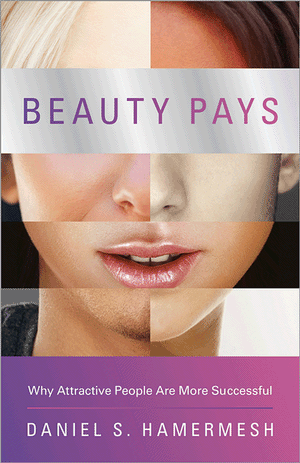
Beauty Pays: Why Attractive People are More Successful. By Daniel Hamermesh
The Beauty Bias: The Injustice of Appearance in Life and Law. By Deborah Rhode
Honey Money: The Power of Erotic Capital. By Catherine Hakim

We of course recommend Hamermesh!
Chapter 8. Legal Protection for the Ugly
Fairness and Public Policy
What Kinds of Protection Are Possible?
How Have Existing Policies Been Used?
Is It Possible to Protect the Ugly?
What Justifies Protecting the Ugly?
What Justifies Not Protecting the Ugly?
What Is an Appropriate Policy?
Protecting the Ugly in the Near Future

Thursday, April 2, 2009

Happy Marriage fact of the Day

a marriage is worth almost £80,000 ($110,000) a year; this reflects partly the fact that marriage makes people happy, but also the fact that we need lots of money to increase our well-being by much.

-Economics in Desperate Housewives

Friday, March 27, 2009

Nassim Taleb on the History of Medicine

What's Taleb upto now;

History of medicine, anti-academic, anti-knowledge. Medicine: whenever we use knowledge as a driver instead of tinkering, we get in trouble. Examples: Our understanding of biological processes led to a decrease in cures. When just tinkering we did better than with directed research. Directed research gives us a strong bias and blinds us to things we don't know are there. In medicine, most medicines are used to cure something completely different from what the intention was. Side-effects dominate. Try to collect positive black swans. Hubris problem, overestimating our knowledge. Difficult to think rationally about uncertainty and risk. Trust the science part, ask the doctor, but the doctor has no idea about the probabilities. Each person, disease is different. Minimize the harm coming from theories. Empirical doctors were successful until eliminated after the rise of Arabic medicine. Western medicine was rationalistic after the Arabic tradition. Improvements after that came from the barbers, not from the doctors. Thinking has not helped us a lot. Evidence in option trading. People think that quants make option formulas, therefore the market uses them. Bogus. Supply and demand. Did a lot better before the Black and Scholes formula...

Religion and probability. Most people think that religion is about belief, but it is about practice. Greek Orthodox but Arabic-speaking. The way Arabs say is not "I don't know" is "God knows." Allows you to say you don't know, transfers from yourself to another entity. Allows you to be humble. History of medicine: accounts of giving a fortune to the Temple of Apollo: You saved me when my doctors failed me. Doctors gave negative contributions, particularly by bleeding; or more recently, delivered a baby after going to the morgue. Brought in religion. Error we have in believing religion is about belief, but it's about commitment, the system, living with something. We're not yet good with ideas. Can see from this crisis. Great Moderation turned out to be not so great. What does probability have to do with religion? Idea of true/false; degree of belief. May do something against the odds because the consequences or large or even without analyzing it. Probability is not opaque; and even if it were, we wouldn't use it because of the consequences. Pascal's wager: Since God might exist, I might as well be a religious person. Payoffs from being religious are much higher than negative payoffs if God doesn't exist. Had to also assume that God doesn't exist and also not know about gaming the system. Maybe actions are more important than beliefs--in some religious systems the actions count. Greek Orthodox, Easter; Judaism, Maimonides, not every Jewish sage lists belief in God as one of the commandments because there is a debate about whether you can mandate belief. In Arabic, the name for religion, din, is the same as the word for law in Hebrew. To be a law-abiding citizen, keep the rules. Hard to keep the rules if you do not keep the faith. Motivating people without faith. Losing patience about people who are skeptics about religion, and at the same time are not skeptical about economics or VAR. Solving our own problems. Hayek, lot of instinct, contributions part of philosophical thinking.

Friday, March 6, 2009

Pornography Fact of the Day


subscriptions to online pornography sites are “more prevalent in states where surveys indicate conservative positions on religion, gender roles, and sexuality.”


via Numbers Guy

Here's the Paper;
Red Light States: Who Buys Online Adult Entertainment?
Benjamin Edelman


The fifth column shows that subscriptions are more prevalent in regions with higher measures of social capital. Following the Social Capital Index developed in Putnam (2000), I obtain DDB Life Style Survey data from 1991 to 1998 on
consumers in 340 metropolitan areas, and I form a social capital index based on
prevalence of people donating blood, engaging in volunteer activities, or participating in community projects. In a region where 1 percent more people participate in these activities, subscriptions to the adult entertainment service are 0.09 percent more widespread.

Saturday, January 24, 2009

Media Trust improves Health

Individuals with high levels of trust in the mass media tend to be healthier, according to a new study of people from 29 Asian countries....

People in Brunei reported the highest levels of health, while those in Turkmenistan had the lowest opinion of their own wellbeing. People in the Maldives reported the highest level of trust in mass media while Hong Kong residents were the most cynical.

-Trusting media may boost health

Saturday, January 17, 2009

Matt Taibbi takes on Thomas Friedman

In The World is Flat, the key action scene of the book comes when Friedman experiences his pseudo-epiphany about the Flat world while talking with himself in front of InfoSys CEO Nandan Nilekani. In Hot, Flat and Crowded, the money shot comes when Friedman starts doodling on a napkin over lunch with Moisés Naím, editor of Foreign Policy magazine. The pre-lunching Friedman starts drawing, and the wisdom just comes pouring out:

I laid out my napkin and drew a graph showing how there seemed to be a rough correlation between the price of oil, between 1975 and 2005, and the pace of freedom in oil-producing states during those same years.

Friedman then draws his napkin-graph, and much to the pundit’s surprise, it turns out that there is almost an exact correlation between high oil prices and “unfreedom”! The graph contains two lines, one showing a rising and then descending slope of “freedom,” and one showing a descending and then rising course of oil prices.

Friedman plots exactly four points on the graph over the course of those 30 years. In 1989, as oil prices are falling, Friedman writes, “Berlin Wall Torn Down.” In 1993, again as oil prices are low, he writes, “Nigeria Privatizes First Oil Field.” 1997, oil prices still low, “Iran Calls for Dialogue of Civilizations.” Then, finally, 2005, a year of high oil prices: “Iran calls for Israel’s destruction.”Take a look for yourself: I looked at this and thought: “Gosh, what a neat trick!” Then I sat down and drew up my own graph, called SIZE OF VALERIE BERTINELLI’S ASS, 1985-2008, vs. HAP- PINESS. It turns out that there is an almost exact correlation! Note the four points on the graph:

-Flat N All That

Monday, September 8, 2008

Let your children watch television and surf the internet

But University of Chicago Graduate School of Business economists Matthew Gentzkow and Jesse Shapiro aren't sure that TV has been all that bad for kids. In a paper published in the Quarterly Journal of Economics this year, they presented a series of analyses that showed that the advent of television might actually have had a positive effect on children's cognitive ability.

The two are part of a tight-knit group of young economists using statistical techniques to examine how television affects society. The group's research suggests TV enabled an earlier generation of American children in non-English-speaking households to do better in school, helped rural Indian women to become more independent and contributed to lowering Brazil's fertility rate.

Mr. Gentzkow, who is 33 and doesn't own a TV set, says that figuring out how television influences children is far from straightforward.

"What are the reasons why some kids watch six hours of TV a day and some kids watch none?" he asks. "Clearly it has to do with their parents and what kind of parenting they're doing; it has to do with how smart they are and how much they like doing other things like reading; it has to do with what socioeconomic resources they have. Do they have a nanny who's taking them to the museum every day versus sitting home alone?"

-Economists Probe the Data on Television Watching And Find It's Not All Bad; Better Test Scores?

Related;
At age 26, Jesse Shapiro practices accessible economics. ‘I’m Happy to Do That.’

Economists Look at How TV Affects Time Use

Monday, August 11, 2008

Assorted

A Tale of Two Charts

More Reasons Not To Take The Candidates' Budget Proposals Too Seriously

Make Diplomacy, Not War

Anne-Marie Slaughter on China;

One of the best books I read on China was Susan Shirk’s “Fragile Superpower,” which argues that for all its energy and emerging power, China is fragile precisely because its political system is just one layer deep. If the Communist Party were to lose power, there is no back-up in place — only the specter of in-fighting fragmentation, chaos, and even civil war. Which is precisely why the government is so worried to stamp out any spark that could potentially ignite wider unrest.

The fragility extends to the economy. If ordinary Chinese suddenly cannot get jobs, or can’t get jobs that will allow them to put food on the table or gas in their motorbikes in an era of rising food and energy prices, there are no years of experience with the business cycle of expansion and recession to cushion the shock of unemployment and belt-tightening. Our current development has happened over decades, fairly steadily since the Depression, but with plenty of bumps along the way. Those psychological layers, just like the layers of our infrastructure, create resilience and strength.

These Olympics, Americans will compete as hard as we possibly can for the gold. Those of our athletes who lose, however, will know that they or their successors will have the chance to compete again; that the nation’s honor does not rest once and for all on their shoulders. America has hosted the Olympics before and will again.

For China, the veneer is much thinner and the stakes are much higher. Beijing has built fantastic Olympic buildings and will put on a dazzling show to tell all the world that it has resumed its rightful place on the global stage. But for all China’s accomplishments, and they are accomplishments, the architecture, infrastructure, economy and even the political system are only one layer deep.

Sunday, August 10, 2008

Turkey Fact of the Day

Turkey's gender gap in years of schooling (of women relative to men) has also been consistently lower than other Muslim countries.

via Iyigun Blog

Not Related;
Turkey Problem

Saturday, August 2, 2008

Religions protect against disease

Corey Fincher, of the University of New Mexico, has a different hypothesis for the origin of religious diversity. He thinks not that religions are like disease but that they are responses to disease—or, rather, to the threat of disease. If he is right, then people who believe that their religion protects them from harm may be correct, although the protection is of a different sort from the supernatural one they perceive.

Mr Fincher is not arguing that disease-protection is religion’s main function. Biologists have different hypotheses for that. Not all follow Dr Dawkins in thinking it pathological. Some see it either as a way of promoting group solidarity in a hostile world, or as an accidental consequence of the predisposition to such solidarity. This solidarity-promotion is one of Mr Fincher’s starting points. The other is that bacteria, viruses and other parasites are powerful drivers of evolution. Many biologists think that sex, for example, is a response to parasitism. The continual mixing of genes that it promotes means that at least some offspring of any pair of parents are likely to be immune to a given disease.

Mr Fincher and his colleague Randy Thornhill wondered if disease might be driving important aspects of human social behaviour, too. Their hypothesis is that in places where disease is rampant, it behoves groups not to mix with one another more than is strictly necessary, in order to reduce the risk of contagion. They therefore predict that patterns of behaviour which promote group exclusivity will be stronger in disease-ridden areas. Since religious differences are certainly in that category, they specifically predict that the number of different religions in a place will vary with the disease load. Which is, as they report in the Proceedings of the Royal Society, the case.

Proving the point involved collating a lot of previous research. Even defining what constitutes a religion is fraught with difficulty. But using accepted definitions of uniqueness, exclusivity, autonomy and superiority to other religions they calculated that the average number of religions per country is 31. The range, though, is enormous—from 3 to 643. Côte d’Ivoire, for example, has 76 while Norway has 13, and Brazil has 159 while Canada has 15. They then did the same thing for the number of parasitic diseases found in each country. The average here was 200, with a range from 178 to 248.

-Religious diversity may be caused by disease


I guess with evolutionary psychology and statistics one can prove almost anything.
Thursday, July 24, 2008

IMF progams bad for your health?

International Monetary Fund Programs and Tuberculosis Outcomes in Post-Communist Countries
These findings indicate that IMF economic programs are associated with significantly worsened tuberculosis control in post-communist Central and Eastern European and former Soviet Union countries, independent of other political, health, and economic changes in these countries. Further research is needed to discover exactly which aspects of the IMF programs were associated with the adverse effects on tuberculosis control reported here and to see whether IMF loans have similar effects on tuberculosis control in other countries or on other non–tuberculosis-related health outcomes. For now, these results challenge the proposition that the forms of economic development promoted by the IMF necessarily improve public health. In particular, they put the onus on the IMF to critically evaluate the direct and indirect effects of its economic programs on public health.


See the IMF reply

Saturday, April 12, 2008

On "good" politicians and "bad" policies

On "good" politicians and "bad" policies - social cohesion, institutions, and growth;
Summary: Social cohesion - that is, the inclusiveness of a country's communities - is essential for generating the trust needed to implement reforms. Citizens have to trust that the short-term losses that inevitably arise from reform, will be more than offset by long-term gains. However, in countries divided along class and ethnic lines, and with weak institutions, even the boldest, most civic-minded and well-informed politician (or interest group) will face severe constraints in bringing about policy reform. The authors hypothesize that key development outcomes (particularly economic growth) are most likely to be associated with countries that are both socially cohesive and governed by effective public institutions. They test this hypothesis for the sample of countries with available data. The authors develop a conceptual framework based on the idea of social cohesion, then review the evidence on which it is based. While several earlier studies have shown that differences in growth rates among developing countries are a result of weak rule of law, lack of democracy, and other institutional deficiencies, the authors focus on the social conditions that give rise to these deficiencies. They also seek to establish empirically a causal sequence from social divisions to weak institutions to slow growth. The essence of their argument, supported by new econometric evidence, is that pro-development policies are comparatively rare in the developing world less because of the moral fiber of politicians (though that surely matters) than because good politicians typically lack the room for maneuver needed to make desired reforms. This lack of maneuverability is a product of insufficient social cohesion and weak institutions. The authors also explore the determinants of social cohesion, focusing on historical accidents, initial conditions, and natural resource endowments. Social cohesion should not be seen as a concern primarily of developing and transition economies. Indeed, it is important in the United Kingdom as in Ukraine, in Canada as in Colombia, in the Netherlands as in Australia.

Tuesday, April 8, 2008

Assorted Pakistan


Demand Analysis For Tax Reform In Pakistan
Angus Deaton and F. Grimard
Abstract: Pakistan, like many LDCs, derives most of government revenue from indirect taxation. However, the system of taxes and subsidies has grown up piecemeal over the years. Previous exercises in price reform for Pakistan have been forced to make very restrictive assumptions about consumer preferences, and have typically used demand systems that prejudge what are the desirable directions of price reform. In this paper, the methodology of Deaton (1988, 1991) is extended and applied to the 1984-85 Household Income and Expenditure Survey. A theory of quality variation based on separable preferences is developed, and the implications for welfare and empirical analysis laid out. The prices of oils and fats and of sugar do not vary very much in the survey data, and the symmetry and homogeneity restrictions from the theory play an important part in obtaining sharp estimates of own and cross-price elasticities. The parameter estimates suggest that there are significant cross-price elasticities between the high-calorie foods and the presence of these substitution patterns means that the effects of potential price reforms are quite different from those that would be estimated using the traditional assumptions. Based on demand patterns alone, it would be desirable to raise government revenue by raising the consumer price of rice. However, in Pakistan it is not generally possible to decouple the producer and consumer prices of rice.


Zakat and Inequality: Some Evidence from Pakistan

This paper presents empirical evidence on the extent to which zakat---a form of religiously-mandated charity under Islam---achieves its intended objective in Pakistan. Detailed income and expenditure data from Pakistan's Household Income and Expenditure Survey for 1987-88 are used to construct two income distributions---one containing the distribution of income which would have obtained if relevant forms of charity were not given, and one containing the distribution of income which obtains under a regime in which such charitable giving takes place. Atkinson-Kolm-Sen (AKS) ethical relative indices of income inequality are computed for Pakistan and each of its four provinces, for each of these two income distributions, and are compared over a range of parameter values. Evidence is found that zakat does redistribute from the better off to the worse-off, and so achieves some reduction in measured income inequality in Pakistan. Both intra-province and inter-province components of over-all inequality decline, though the amount of change is generally small. These conclusions are shown to be robust to a wide range of normative values the investigator may select.


An Islamic Perspective on Inequality in Pakistan;
This paper examines the distribution of income in Pakistan, and in each of its four provinces, from an explicit and formal Islamic perspective. A cardinally significant Atkinson--Kolm--Sen relative index of inequality reflecting that perspective is proposed and computed from the full HIES data series for the years 1984-85, 1985-86, 1986-87, and 1987-88. There is evidence of a significant decline in overall inequality in Pakistan from 1984-85 to 1987-88, but the level of inequality remains very high. Inter--province and inter--urban/rural differences in inequality profiles within Pakistan and each of its provinces are found to be generally less significant than intra--province and intra--urban/rural differences.

Monday, April 7, 2008

Democrats can count on the 'Colbert bump'

Hillary Clinton is out of money. She recently loaned $5 million to her own campaign just as Barack Obama was setting records by raising $32 million in January. As the two of them race ahead, winning the money game now is more important than ever. But where can she turn? Two words: Stephen Colbert.

In character, Colbert claims that anyone who comes on his Comedy Central show, "The Colbert Report," receives a boost in popularity that immediately vaults the guest to stardom, fame and fortune. Fans have pointed to several pieces of evidence that the "Colbert bump" is real. Colbert helped former Orleans singer John Hall win his seat in Congress. Ned Lamont came on the show and then promptly beat Sen. Joe Lieberman in the Connecticut primary. And in this year's presidential race, popular support for Ron Paul doubled and for Mike Huckabee tripled immediately after they appeared on the show (never mind that they both started at a paltry 1%). At that rate of increase, Colbert quipped, Huckabee could be the first candidate ever to win 88,128,000% of the vote.

But these efforts to measure Colbert's influence don't even qualify as "truthy." For example, one method involved averaging the percentage of the vote earned by each candidate who had appeared on the show. Because 89% of them were incumbents (several running unopposed), it is hardly surprising that they beat their opponents by 34 percentage points on average.

Such amateur statistics fall prey to the problem of self-selection -- candidates with secure seats may be much more likely than others to risk televised humiliation. Just ask Georgia Republican Rep. Lynn A. Westmoreland, who advocates putting the Ten Commandments on the walls of Congress -- he could only name three of them on the show -- or Florida Democrat Rep. Robert Wexler, whom Colbert goaded into saying he liked cocaine and prostitutes "because it's a fun thing to do." Both were incumbents facing no serious competition.

But it is possible to control for the self-selection problem by also examining similar candidates to those who went on "The Colbert Report." So that's exactly what I did in my study. I matched Republicans to other Republicans, incumbents to other incumbents, and so on. (Colbert might call his guests the "Hall of Heroes" and the similar-looking "control" group that didn't go on the show the "Hall of Cowards.") I then used data from the Federal Election Commission to see whether being on the show had an effect on campaign contributions.

So what did I find? As it turns out, the Republican candidates who appear on the show don't fare any better -- if anything they might actually do a little worse than their fellow Republicans who stayed home. However, Democratic candidates who appear on "The Report" receive 44% more money than those who do not in the first month after their appearance. We no longer have to rely on the gut or Wikipedia -- the evidence speaks for itself.

House Speaker Nancy Pelosi said she wouldn't recommend anyone go on "The Colbert Report," but these results show that Democrats who ignored her advice probably did themselves a favor. For Democrats, the "Colbert bump" is financially measurable, and it may be just what they need to keep control of the Congress in 2008.

And for Clinton, who now more than ever appears to need the money, calling Colbert just might be the smartest move of her campaign.

-Sharing the wealthiness