Showing posts with label Social Capital. Show all posts

Friday, August 26, 2011

The Age of Erotic Capital? Legal Protection for the Ugly?

over a lifetime and assuming today’s mean wages, a handsome worker in America might on average make $230,000 more than a very plain one.
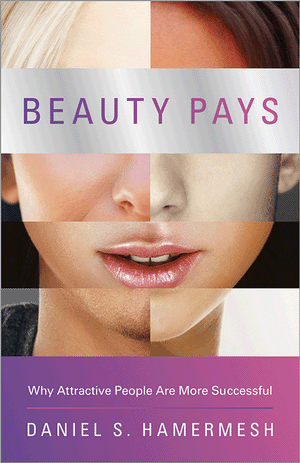
The Economist reviews three books on beauty;
Beauty Pays: Why Attractive People are More Successful. By Daniel Hamermesh
The Beauty Bias: The Injustice of Appearance in Life and Law. By Deborah Rhode
Honey Money: The Power of Erotic Capital. By Catherine Hakim

We of course recommend Hamermesh!
Chapter 8. Legal Protection for the Ugly
Fairness and Public Policy
What Kinds of Protection Are Possible?
How Have Existing Policies Been Used?
Is It Possible to Protect the Ugly?
What Justifies Protecting the Ugly?
What Justifies Not Protecting the Ugly?
What Is an Appropriate Policy?
Protecting the Ugly in the Near Future

Saturday, April 17, 2010

Is Marriage good for you?

Contemporary studies, for instance, have shown that married people are less likely to get pneumonia, have surgery, develop cancer or have heart attacks. A group of Swedish researchers has found that being married or cohabiting at midlife is associated with a lower risk for dementia. A study of two dozen causes of death in the Netherlands found that in virtually every category, ranging from violent deaths like homicide and car accidents to certain forms of cancer, the unmarried were at far higher risk than the married. For many years, studies like these have influenced both politics and policy, fueling national marriage-promotion efforts, like the Healthy Marriage Initiative of the U.S. Department of Health and Human Services. From 2006 to 2010, the program received $150 million annually to spend on projects like “divorce reduction” efforts and often cited the health benefits of marrying and staying married.

-Is Marriage Good for Your Health?

Thursday, March 11, 2010

Chutes and Ladders in Harlem


A highly recommended podcast from EconTalk with Katherine Newman,a sociologist at Princeton.

Friday, March 5, 2010

The Revenge of the Artist


Ion Barladeanu;

"I feel as if I have been born again," he said, as some of France's leading collectors and curators jostled for position to see his collages. "Now I feel like a prince. A pauper can become a prince. But he can go back to being a pauper too."...

Barledeanu describes himself as a "director" of his own films and considers each collage to be a movie in itself. While many are light-hearted, others are darker, infused with black humour and often focusing on the man he calls his "greatest fear". "I knew that if he knew about my work Ceausescu would not sleep in peace in his grave," he said. "If people had found out about my work they could have chopped my head off … But this is my revenge."...

Whatever the world thinks, Barladeanu says he will carry on working regardless. "It's like eating pie or sandwiches. It fulfils me," he said in his fast-paced Romanian slang. "If I were reincarnated in another life I would still be making collages, and if I could take them to the moon I would."


Sunday, November 22, 2009

Think about for the Day

In the United States today, democracy means that most people have essentially zero political power, and a relative handful of people have almost unimaginable power. The central point of Unchecked and Unbalanced is to call attention to the extreme political inequality that has emerged in the United States, particularly over the past fifty years.

-Arnold Kling

Friday, March 6, 2009

Pornography Fact of the Day


subscriptions to online pornography sites are “more prevalent in states where surveys indicate conservative positions on religion, gender roles, and sexuality.”


via Numbers Guy

Here's the Paper;
Red Light States: Who Buys Online Adult Entertainment?
Benjamin Edelman


The fifth column shows that subscriptions are more prevalent in regions with higher measures of social capital. Following the Social Capital Index developed in Putnam (2000), I obtain DDB Life Style Survey data from 1991 to 1998 on
consumers in 340 metropolitan areas, and I form a social capital index based on
prevalence of people donating blood, engaging in volunteer activities, or participating in community projects. In a region where 1 percent more people participate in these activities, subscriptions to the adult entertainment service are 0.09 percent more widespread.

Saturday, January 24, 2009

From Crotch Crescent to Penistone


In the scale of embarrassing place names, Crapstone ranks pretty high. But Britain is full of them. Some are mostly amusing, like Ugley, Essex; East Breast, in western Scotland; North Piddle, in Worcestershire; and Spanker Lane, in Derbyshire.

Others evoke images that may conflict with residents’ efforts to appear dignified when, for example, applying for jobs.

These include Crotch Crescent, Oxford; Titty Ho, Northamptonshire; Wetwang, East Yorkshire; Slutshole Lane, Norfolk; and Thong, Kent. And, in a country that delights in lavatory humor, particularly if the word “bottom” is involved, there is Pratts Bottom, in Kent, doubly cursed because “prat” is slang for buffoon.

As for Penistone, a thriving South Yorkshire town, just stop that sophomoric snickering.

“It’s pronounced ‘PENNIS-tun,’ ” Fiona Moran, manager of the Old Vicarage Hotel in Penistone, said over the telephone, rather sharply. When forced to spell her address for outsiders, she uses misdirection, separating the tricky section into two blameless parts: “p-e-n” — pause — “i-s-t-o-n-e.”

-No Snickering: That Road Sign Means Something Else

Sunday, July 27, 2008

Tuesday, May 27, 2008

Indonesia- A Budding Democracy

Vice-president thinks the country is 'too free'?

Friday, May 9, 2008

Social Capital and Gender in Italy

Berlusconi publicly mocked spanish Prime Minister José Luis Rodríguez Zapatero for hiring too many women, saying, “Zapatero has formed a government that is too pink, something that we cannot do in Italy because there is a prevalence of men in politics and it isn’t easy to find women who are qualified.”

-Gender equality, Berlusconi-style

Saturday, April 26, 2008

Glassbooth


Glassbooth is a nonprofit organization that is creating innovative ways to access political information. An informed and interested democracy is a powerful thing.

Saturday, April 12, 2008

On "good" politicians and "bad" policies

On "good" politicians and "bad" policies - social cohesion, institutions, and growth;
Summary: Social cohesion - that is, the inclusiveness of a country's communities - is essential for generating the trust needed to implement reforms. Citizens have to trust that the short-term losses that inevitably arise from reform, will be more than offset by long-term gains. However, in countries divided along class and ethnic lines, and with weak institutions, even the boldest, most civic-minded and well-informed politician (or interest group) will face severe constraints in bringing about policy reform. The authors hypothesize that key development outcomes (particularly economic growth) are most likely to be associated with countries that are both socially cohesive and governed by effective public institutions. They test this hypothesis for the sample of countries with available data. The authors develop a conceptual framework based on the idea of social cohesion, then review the evidence on which it is based. While several earlier studies have shown that differences in growth rates among developing countries are a result of weak rule of law, lack of democracy, and other institutional deficiencies, the authors focus on the social conditions that give rise to these deficiencies. They also seek to establish empirically a causal sequence from social divisions to weak institutions to slow growth. The essence of their argument, supported by new econometric evidence, is that pro-development policies are comparatively rare in the developing world less because of the moral fiber of politicians (though that surely matters) than because good politicians typically lack the room for maneuver needed to make desired reforms. This lack of maneuverability is a product of insufficient social cohesion and weak institutions. The authors also explore the determinants of social cohesion, focusing on historical accidents, initial conditions, and natural resource endowments. Social cohesion should not be seen as a concern primarily of developing and transition economies. Indeed, it is important in the United Kingdom as in Ukraine, in Canada as in Colombia, in the Netherlands as in Australia.

Quote of the Day

"Good government in Italy is a by-product of singing groups and soccer clubs, not prayer."- Robert Putnam

Friday, April 11, 2008

How superdelegates can destroy the future of American democracy

Robert Putnam weighs in;

Throughout the last four decades of the 20th century, young people's engagement in American civic life declined year after year with depressing regularity. In fall 1966, well before the full flowering of Vietnam War protests, a UCLA poll of college freshmen nationwide found that "keeping up with politics" was a "very important" goal in their lives for fully 60 percent.

Thirty-four years later that figure had plummeted to 28 percent. In 1972, when the vote was first extended to 18-year-olds, turnout in the presidential election among 18- to 24-year-olds was a disappointing 52 percent. But even beginning at that modest level, rates of voting in presidential elections by young people steadily fell throughout the '70s, '80s, and '90s, reaching barely 36 percent in 2000. National commissions bemoaned the seemingly inexorable increase in youthful apathy and incivism. The National Commission on Civic Renewal said, "When we assess our country's civic and moral condition, we are deeply troubled. . . . We are in danger of becoming a nation of spectators."

Then came the attacks of Sept. 11, 2001, a national tragedy, but also a vivid reminder that we are all in this together. Civic seismometers across the land showed a sharp spike in virtually every measure of community-mindedness. It was, I wrote at the time, not only a tragedy, but also the sort of opportunity for civic revival that comes along once or twice a century. Just as Pearl Harbor had spawned the civic-minded "Greatest Generation," so too Sept. 11 might turn out to produce a more civically engaged generation of young people.

For most Americans the half-life of the civic boomlet after the attacks was barely six months. Within a year measures of civic engagement had returned to the previous levels, from which they have barely budged since. Except among young people.

Among the cohort of Americans caught by 9/11 in their formative years, the effects of the attacks on their civic consciousness were more enduring. The annual UCLA chart of interest in politics jumped upward in 2001 for the first time in decades and has kept rising every year since.

Last month the UCLA researchers reported that "For today's freshmen, discussing politics is more prevalent now than at any point in the past 41 years." This and other evidence led us and other observers to speak hopefully of a 9/11 generation, perhaps even a "new Greatest Generation." In the 2004 and 2006 elections, turnout among young people began at last to climb after decades of decline, reaching the highest point in 20 years in 2006. As we approached the presidential season of 2008, young Americans were, in effect, coiled for civic action, not because of their stage of life, but because of the lingering effects of the unifying national crisis they had experienced in their formative years.

The exceptionally lively presidential nominating contests of this year - and, it must be said, the extraordinary candidacy of Barack Obama - have sparked into white hot flame a pile of youthful kindling that had been stacked and ready to flare for more than six years. The 18-year-olds first eligible to vote in 2008 were in sixth grade when the twin towers fell, and their older sisters and brothers who were college seniors in September 2001 are now 28 or 29. It is precisely this group, above all others in America, that has pushed participation rates in this spring's caucuses and primaries to record levels. Turnout in this spring's electoral contests so far has generally been higher than in previous presidential nominating contests, but for twentysomethings the rise has been truly phenomenal - turnout often three or four times greater than ever before measured.

The 2008 elections are thus the coming-out party of this new Greatest Generation. Their grandparents of the original Greatest Generation were the civic pillars of American democracy for more than a half-century, and at long last, just as that generation is leaving the scene, reinforcements are arriving. Americans of every political persuasion should rejoice at this epochal swing of the generational pendulum, for it portends precisely the sort of civic renaissance for which Jeremiahs have been calling for many years.

This, then, is what is at stake in the otherwise inside-baseball controversies about superdelegates and pledged delegates and the uncontested Florida and Michigan primaries - controversies now roiling Democratic party leaders. If the results of the caucuses and primaries are, despite record-breaking rates of popular participation, overturned by unelected (though officially legitimate) superdelegates or by delegates from states that all candidates had previously agreed not to contest, the lesson for the young civic stalwarts would be unmistakable - democratic politics is a sham. Politics is actually controlled by party bosses behind the scenes. Civic engagement is for suckers.

From Little League to student council races, we all learn to accept defeats we have lost fair and square. But losing in a contest in which the rules can be rigged teaches that the game is not worth the candle. Who can honestly doubt that if the Democratic presidential candidate preferred by a majority of the delegates elected in this spring's competitive contests (and by the overwhelming majority of young voters) were to be rejected solely by the power of unelected delegates (or those "elected" without any serious competition), the unmistakable civics lesson would be catastrophic for this incipient cadre of super citizens?

So as the superdelegates, the two campaigns, and Democratic Party leaders contemplate how to resolve the procedural issues before them - what to do about Michigan and Florida, and how superdelegates should vote - let's hope that they weigh the consequences not merely for their own candidates this year, and not merely for the Democratic prospects in the fall, but for the future vitality of American democracy.

Thinking about Social Capital and getting a head-ache

Possible paper topics for class on social capital by Robert Putnam;

  • Which interpretation of the 1950s do you find more persuasive— Ehrenhalt or “Pleasantville”? Could one “edit” the 1950s to eliminate the “bad parts” and keep the “good parts”? Which are the good parts and which the bad parts?
  • In what ways does the concept of social capital illuminate or obscure? Where is the frontier in social capital theory?
  • Does the Progressive Era constitute an attractive and appropriate inspiration for our own times or not? Was it about social capital or social control?
  • What is the “social capital” diagnosis of America’s urban problems? How persuasive is it?
  • How (if at all) are social capital and education related?
  • Have we made our places, or have our places made us? How? What can we do about it?
  • Is the younger generation today really any different from young people always? If so, how and why?
  • Is the workplace part of the problem or part of the solution?
  • What are the strengths and weaknesses of religiously based social capital?
  • Is “virtual community” really community? Will the Internet make the problem of social capital better or worse?
  • How do immigration and ethnic diversity affect social capital? How are bridging and bonding social capital related? If there is a policy problem here, what can we do about it?
  • Is restoring social capital necessary, sufficient, or irrelevant for making American democracy work better? If it is necessary or sufficient, how do we do it?