Showing posts with label Democracy and Freedom. Show all posts

Saturday, December 4, 2010

Learn from Bees

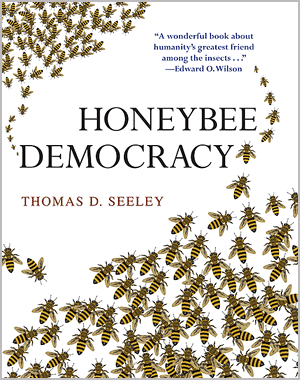
In the final chapter, Seeley suggests five lessons we could learn from bees.

• Compose a decision-making group of individuals with shared interests. Here bees have a higher stake than us: all members of a colony are related (sisters) and nobody can survive without the group.

• Minimise the leader's influence on the group. Here we humans have much to learn.

• Seek diverse solutions to the problem. Humans realised only recently that diversity is good for a group.

• Update the group's knowledge through debate. Here again, bees are superior to us, as each scout's "dances" become less effective with time, no matter how good a new site is, while stubbornness can lead humans to argue forever.

• Use quorums to gain cohesion, accuracy and speed. Impressively, bees came up with this concept long before the Greeks.
Thursday, July 15, 2010

Neuroscience and Democracy

Quote of the Day

"From the perspective of the human brain, it's a miracle that democracy works at all"

Source:

Friday, March 5, 2010

The Revenge of the Artist


Ion Barladeanu;

"I feel as if I have been born again," he said, as some of France's leading collectors and curators jostled for position to see his collages. "Now I feel like a prince. A pauper can become a prince. But he can go back to being a pauper too."...

Barledeanu describes himself as a "director" of his own films and considers each collage to be a movie in itself. While many are light-hearted, others are darker, infused with black humour and often focusing on the man he calls his "greatest fear". "I knew that if he knew about my work Ceausescu would not sleep in peace in his grave," he said. "If people had found out about my work they could have chopped my head off … But this is my revenge."...

Whatever the world thinks, Barladeanu says he will carry on working regardless. "It's like eating pie or sandwiches. It fulfils me," he said in his fast-paced Romanian slang. "If I were reincarnated in another life I would still be making collages, and if I could take them to the moon I would."


Friday, July 10, 2009

You've the right to remain ------


The Urumqi government said Friday that families of "innocent" people killed in the unrest will receive about $29,300 in compensation, but it was unclear how officials would make that determination.

Thursday, September 4, 2008

Quote of the Day

[D]emocracy does not mean and cannot mean that the people actually rule in any obvious sense of the terms 'people' and 'rule.' Democracy means only that the people have the opportunity of accepting or refusing the men who are to rule them. But since they might decide this also in entirely undemocratic ways, we have had to narrow our definition by adding a further criterion identifying the democratic method, viz., free competition among would-be leaders for the vote of the electorate.

- Schumpeter in 1942

Saturday, August 23, 2008

The Award for protesters in China


One in year jail for 79 year old illiterate lady- and electricity was also cut from her apartment.


Meanwhile Chinese youth embrace Communism;

Friday, August 15, 2008

Good luck

Lugo 'to end' Paraguay corruption

Nuke, Kooks and Democracy in Iran


Abbas Milani's talk will be "Nuke, Kooks and Democracy in Iran: a discussion of Iran's current political situation, and the prospects of democracy, and a resolution of the country's nuclear program." His most recent book is Tales of Two Cities: A Persian Memoir.


-Iran signed an agreement with MIT to train 100 nuclear scientists in 1976
-Khomeni stopped the program after the revolution, started it after Saddam's use of chemical weapons (and when the world ignored it).


Related;
Islamic Republic of Iran: 2008 Article IV Consultation - Staff Report

Islamic Republic of Iran: Selected Issues

Sunday, August 10, 2008

Dictators and binding revolution constraints

The dictator’s approach to electoral patterns;
Democracies rarely repress their own citizens but authoritarian and totalitarian regimes do. According to one estimate (See Table 1), of the 110 million persons repressed by Marxist-Leninist regimes in the twentieth century, more than 90% were their own citizens. In democracies, less than 0.5% of victims were own citizens. It is statistics, such as these, that suggest some "generality" in Stalin's behaviour. Empirical studies also suggest that totalitarian regimes generate more "violence" than democracies (Mulligan, Gil, Sala-I-Martin, 2004)...

Our model suggests that the number of eliminations depends on the probability of correctly identifying enemies, the number of enemies, and the “threat” that the enemy poses. Although we are unable to “prove” our model based on the stylised facts of the three repressions, we can show that the model is consistent with these facts. The model makes one prediction that is consistent with Stalin’s observed behaviour that is far from intuitively obvious. A rational dictator will deliberately eliminate innocent citizens and will eliminate more innocents when enemies are difficult to identify. Stalin’s slaughter of innocents is cited by historians as a sign of his mental derangement, but in our model it is the predicted behaviour of a dictator facing a binding revolution constraint.

Thursday, August 7, 2008

Mugabe wins a Gold Medal


Lewis Black gives away Evil Dictator Awards- Mugabe wins Gold Medal for changing Zimbabweans into a nation of starving Rockefellers.

The Idea that is America at its best

In a pointed gesture, the U.S. Olympic team has voted Lopez Lomong, a member of the track team who gained American citizenship in 2007 after fleeing Sudan and spending a decade in a Kenyan refugee camp, as its flag bearer for the opening ceremony in Beijing.

-Sudanese refugee voted American flag bearer

Sunday, August 3, 2008

Book recommendation


Inventing Human Rights: A History by Lynn Hunt

Review of the book by NYT

Responsibility of Artists- To defeat the lie

Aleksandr Solzhenitsyn Dies at 89;
He wrote that while an ordinary man was obliged “not to participate in lies,” artists had greater responsibilities. “It is within the power of writers and artists to do much more: to defeat the lie!”...

Many in the West did not know what to make of the man. He was perceived as a great writer and hero who had defied the Russian authorities. Yet he seemed willing to lash out at everyone else as well — democrats, secularists, capitalists, liberals and consumers.

David Remnick, the editor of The New Yorker, who has written extensively about the Soviet Union and visited Mr. Solzhenitsyn, wrote in 2001: “In terms of the effect he has had on history, Solzhenitsyn is the dominant writer of the 20th century. Who else compares? Orwell? Koestler? And yet when his name comes up now, it is more often than not as a freak, a monarchist, an anti-Semite, a crank, a has been.”

In the 1970s, Secretary of State Henry A. Kissinger warned President Gerald R. Ford to avoid seeing Mr. Solzhenitsyn. “Solzhenitsyn is a notable writer, but his political views are an embarrassment even to his fellow dissidents,” Mr. Kissinger wrote in a memo. “Not only would a meeting with the president offend the Soviets, but it would raise some controversy about Solzhenitsyn’s views of the United States and its allies.” Mr. Ford followed the advice.

The writer Susan Sontag recalled a conversation about Mr. Solzhenitsyn between her and Joseph Brodsky, the Russian poet who had followed Mr. Solzhenitsyn into forced exile and who would also become a Nobel laureate. “We were laughing and agreeing about how we thought Solzhenitsyn’s views on the United States, his criticism of the press, and all the rest were deeply wrong, and on and on,” she said. “And then Joseph said: ‘But you know, Susan, everything Solzhenitsyn says about the Soviet Union is true. Really, all those numbers — 60 million victims — it’s all true.’ ”...

In the autumn of 1961, Aleksandr Solzhenitsyn was a 43-year-old high school teacher of physics and astronomy in Ryazan, a city some 70 miles south of Moscow. He had been there since 1956, when his sentence of perpetual exile in a dusty region of Kazakhstan was suspended. Aside from his teaching duties, he was writing and rewriting stories he had conceived while confined in prisons and labor camps since 1944.

One story, a short novel, was “A Day in the Life of Ivan Denisovich,” an account of a single day in an icy prison camp written in the voice of an inmate named Ivan Denisovich Shukov, a bricklayer. With little sentimentality, he recounts the trials and sufferings of “zeks,” as the prisoners were known, peasants who were willing to risk punishment and pain as they seek seemingly small advantages like a few more minutes before a fire. He also reveals their survival skills, their loyalty to their work brigade and their pride.

The day ends with the prisoner in his bunk. “Shukov felt pleased with his life as he went to sleep,” Mr. Solzhenitsyn wrote. Shukov was pleased because, among other things, he had not been put in an isolation cell, and his brigade had avoided a work assignment in a place unprotected from the bitter wind, and he had swiped some extra gruel, and had been able to buy a bit of tobacco from another prisoner.

“The end of an unclouded day. Almost a happy one,” Mr. Solzhenitsyn wrote, adding: “Just one of the 3,653 days of his sentence, from bell to bell. The extra three days were for leap years.”

Mr. Solzhenitsyn typed the story single spaced, using both sides to save paper. He sent one copy to Lev Kopelev, an intellectual with whom he had shared a cell 16 years earlier. Mr. Kopelev, who later became a well known dissident, realized that under Mr. Khrushchev’s policies of liberalization, it might be possible to have the story published by Novy Mir, or The New World, the most prestigious of the Soviet Union’s so-called thick literary and cultural journals. Mr. Kopelev and his colleagues steered the manuscript around lower editors who might have blocked its publication and took it to Aleksandr Tvardovsky, the editor and a Politburo member who backed Mr. Khrushchev.

On reading the manuscript, Mr. Tvardovsky summoned Mr. Solzhenitsyn from Ryazan. “You have written a marvelous thing,” he told him. “You have described only one day, and yet everything there is to say about prison has been said.” He likened the story to Tolstoy’s moral tales. Other editors compared it to Dostoevsky’s “House of the Dead,” which the author had based on his own experience of incarceration in czarist times. Mr. Tvardovsky offered Mr. Solzhenitsyn a contract worth more than twice his teacher’s annual salary, but he cautioned that he was not certain he could publish the story.

Mr. Tvardovsky was eventually able to get Mr. Khrushchev himself to read “A Day in the Life.” Mr. Khrushchev was impressed, and by mid-October 1962, the presidium of the Politburo took up the question of whether to allow it to be published. The presidium ultimately agreed, and in his biography “Solzhenitsyn” (Norton, 1985), Michael Scammell wrote that Mr. Khrushchev defended the decision and was reported to have declared: “There’s a Stalinist in each of you; there’s even a Stalinist in me. We must root out this evil.”

The novel appeared in Novy Mir in early 1963. The critic Kornei Chukovsky pronounced the work “a literary miracle.” Grigori Baklanov, a respected novelist and writer about World War II, declared that the story was one of those rare creations after which “it is impossible to go on writing as one did before.”

Novy Mir ordered extra printings, and every copy was sold. A book edition and an inexpensive newspaper version also vanished from the shelves.

Mr. Solzhenitsyn was not the first to write about the camps. As early as 1951, Gustav Herling, a Pole, had published “A World Apart,” about the three years he spent in a labor camp on the White Sea. Some Soviet writers had typed accounts of their own experiences, and these pages and their carbon copies were passed from reader to reader in a clandestine, self-publishing effort called zamizdat. Given the millions who had been forced into the gulag, few families could have been unaware of the camp experiences of relatives or friends. But few had had access to these accounts. “A Day in the Life” changed that...

In an interview last year with Der Spiegel, Mr. Solzhenitsyn said that Russians’ view of the West as a “knight of democracy” had been shattered by the NATO bombing of Serbia, an event he called “a grave disillusion, a crushing of ideals.” He dismissed Western democracy-building efforts, telling the Times of London in 2005 that democracy “is not worth a brass farthing if it is installed by bayonet.”

In 2007, he accepted a State Prize from then-President Putin — after refusing, on principle, similar prizes from Gorbachev and from Yeltsin. Mr. Putin, he said in the Der Spiegel interview, “inherited a ransacked and bewildered country, with a poor and demoralized people. And he started to do what was possible — a slow and gradual restoration.”


Related;