When doing the statistics, one key issue is how to measure violence. Pinker often favors “per capita” measures, but I am not so sure. I might prefer a weighted average of per capita and “absolute quantity of violence” measures. Killing six million Jews in the Holocaust is not, in my view, “half as violent” if global population is twice as high. Once you toss in the absolute measures with the per capita measures, the long-term trends are not nearly as favorable as Pinker suggests.
Showing posts with label Culture. Show all posts
Showing posts with label Culture. Show all posts
Wednesday, November 9, 2011
A book worth thinking and reading

Monday, September 26, 2011

Friday, September 23, 2011
Marketers target Men
Marketers are also devoting much more effort to marketing to men—or, as Mr Lindstrom puts it, getting men to shop like women. In 1995 only 53% of American men admitted to shopping for themselves. That figure has risen to 75%. Many are buying traditionally “female” products; marketers created a $27 billion “male grooming” industry from nothing. They bombard men with images that were once reserved for women: think of Abercrombie & Fitch’s buff, topless hunks. (Not all hunks are appealing, however. The firm offered to pay a star of “Jersey Shore”, a crass reality show, not to wear its clothes.)- Source: The Economist
Friday, September 2, 2011
Samuel Menashe passed away

'Pity us / By the sea / On the sands / So briefly'
More here
Friday, August 26, 2011
The Age of Erotic Capital? Legal Protection for the Ugly?
over a lifetime and assuming today’s mean wages, a handsome worker in America might on average make $230,000 more than a very plain one.
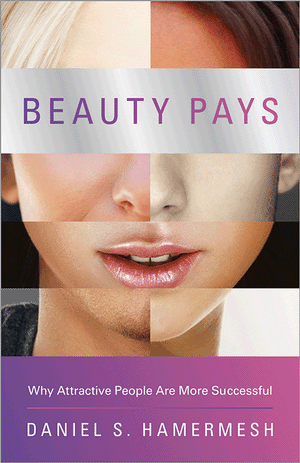
The Economist reviews three books on beauty;
Beauty Pays: Why Attractive People are More Successful. By Daniel Hamermesh
The Beauty Bias: The Injustice of Appearance in Life and Law. By Deborah Rhode
Honey Money: The Power of Erotic Capital. By Catherine Hakim
We of course recommend Hamermesh!
Chapter 8. Legal Protection for the Ugly
Fairness and Public Policy
What Kinds of Protection Are Possible?
How Have Existing Policies Been Used?
Is It Possible to Protect the Ugly?
What Justifies Protecting the Ugly?
What Justifies Not Protecting the Ugly?
What Is an Appropriate Policy?
Protecting the Ugly in the Near Future
Friday, August 5, 2011


Monday, November 15, 2010
Book Cover Art - Sex at Dawn - and thoughts for reflection
"Researchers have confirmed what most men already know: men tend to get turned on by images depicting an environment in which sperm competition is clearly at play (though few, we imagine, think of it in quite these terms). Images and videos showing one woman with multiple males are far more popular on the Internet and in commercial pornography than those depicting one male with multiple females. A quick peek at the online offerings at Adult Video Universe lists over nine hundred titles in the Gangbang genre, but only twenty-seven listed under Reverse Gangbang. You do the math. Why would the males in a species that’s been wearing the shackles of monogamy for 1.9 million years be sexually excited by scenes of groups of men ejaculating with one or two women?
As far as we know, there is no corresponding taste among women for erotica featuring multiple overweight middle-aged ladies with cheap tattoos, bad haircuts, and black socks having sex with one hot guy. Go figure.

Monday, September 20, 2010

Wednesday, July 28, 2010


Friday, July 23, 2010
Cool Blogs
Michele Roohani
Arcane Sentiment
Economics
Daily Expositions
Agent Continuum
Cafe Salemba
James MacLean
Taro Econ Blog
“Life is short, art is long, opportunity fleeting, experiment treacherous, judgment difficult.”
Arcane Sentiment
Economics
Daily Expositions
Agent Continuum
Cafe Salemba
James MacLean
Taro Econ Blog
Thursday, July 22, 2010
Grey areas abound in religion
Something to think about for the young Muslim.
Life is all about the grey area. When I was growing up I wasn't sure where I belonged in the world of religion. The way religion was taught in the Arab world was always in absolutes. While I didn't know much when I was young, I knew that I could not live in a black or white, either-or world. This was made most clear through a sermon delivered by a young imam who was studying for his doctorate at the Harvard Divinity School.-Dr. Naif Al-Mutawa
Speaking to a group of Muslim students, Imam Talal Eid said, "If you ask me whether charging interest is haram (forbidden) in Islam, I would say yes and I would quote chapter and verse from the Qur'an for you."
After a long pause, he went on to say, "But if I didn't pay for my car with an installment loan, I wouldn't be able to come here to talk to you about Islam."
With that simple, expressive example between the absolute and the relative, the imam carved out a place of tolerance and compromise for me. He made it safe for me to be the judge of my own actions, to set my own course, to walk to the beat of my own drum. He made it safe to make my own rules using the lessons I learned with the heart and mind that God gave me. No one could force me to walk away from my duty as a Muslim, by insisting there was only one way to live my life and practice my faith.
Saturday, July 10, 2010

Saturday, June 19, 2010
Why Arabs love Turkish soaps?
-Turks Put Twist in Racy SoapsIf this seems like a triumph of Western values by proxy, the Muslim context remains the crucial bridge. “Ultimately, it’s all about local culture,” said Irfan Sahin, the chief executive of Dogan TV Holding, Turkey’s largest media company, which owns Kanal D. “People respond to what’s familiar.” By which he meant that regionalism, not globalism, sells, as demonstrated by the finale of “Noor” last summer on MBC, the Saudi-owned, Dubai-based, pan-Arab network that bought rebroadcast rights from Mr. Sahin. A record 85 million Arab viewers tuned in.
That said, during the last 20 years or so Turkey has ingested so much American culture that it has experienced a sexual revolution that most of the Arab world hasn’t, which accounts for why “Noor” triumphed in the Middle East but was considered too tame for most Turks. Even Mr. Sahin wonders, by contrast, whether the racier “Ask-i Memnu,” a smash with young Turks, threatens to offend Arabs unless it is heavily edited.
“You have to understand that there are people still living even in this city who say they only learned how to kiss or learned there is kissing involved in lovemaking by watching ‘Noor,’ explained Sengul Ozerkan, a professor of television here who conducts surveys of such things. “So you can imagine why the impact of that show was so great in the Arab world and why ‘Ask-i Memnu’ may be too much.
“But then, Turkey always acts like a kind of intermediary between the West and the Middle East,” she added.

Saturday, June 12, 2010
The Art of Defining Marriage
The unit’s lore is worthy of its own reality TV series — sham couples caught red-handed, yes, but also quirky ones whose authenticity surprised everyone. The gay man who claimed he had suddenly found his female soul mate (denied); the recovering alcoholic who had lost his memory (approved); the man who volunteered that he had erectile dysfunction in an attempt to explain why his mate did not know the location of his nine tattoos (unsuccessful); the elderly citizen who lost an arm in a subway accident, but found happiness with a young Caribbean wife (successful).
“We can’t impose our definition of marriage, especially being in New York,” said Maria Guerra, a Stokes supervisor. “We’ve seen it all.”
-Do You Take This Immigrant?
Friday, June 11, 2010

Sunday, May 16, 2010
Artist of the Day- Tsilli Pines

According to Pines, the piece she created for this issue of the magazine, above, titled, "Corporations," isn't just about the way accounting practices are "wacky on such a large scale for so many businesses." To her, "everything, from the way we are trying to make up for personal losses to the way the economy is being propped up, feels like it's being put back together imperfectly

This series is about the topography of money in human consciousness, the constant parade of numbers in everyday life. The figures are at once imaginary and very real. I’m interested in the power numbers have in our lives, and how much they dictate, both psychologically and actually.
Here's the artist on Flick
Wednesday, May 5, 2010
How much do you think the following is worth?

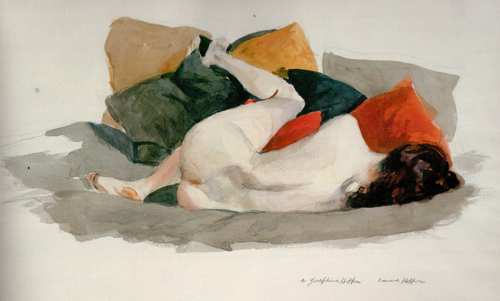
In an overflowing salesroom at Christie’s, six bidders vied for “Nude, Green Leaves and Bust,” which depicts the artist’s mistress Marie-Thérèse Walter, reclining naked. When the canvas last changed hands, in 1951, it sold for $19,800. But this time, “Nude, Green Leaves and Bust” brought $106.5 million.
-At $106.5 Million, a Picasso Sets an Auction Record
Saturday, April 24, 2010
Sex, Bombs & Burgers
The talk will focus on the main theme of the book, which is how the military, porn and food industries have been the biggest drivers of technology over the past century. The links between these three are not immediately clear, but they are all rooted in humanity's basest instincts. In essence, my book is about how the worst parts of human vice have resulted in some truly incredible achievements
It's no secret that porn is a major force on the internet - an estimated 25 per cent of all search requests are for adult content, while about one third of all websites are pornography-related. About 28,000 people are watching porn of some kind online , spending about $89 doing so, every second.
Porn, despite being commonly thought of as a negative by-product of one of our basest instincts (the need to have sex), has been a big force for innovation over the past century.
Subscribe to:
Posts (Atom)
Our Other Blogs


Sun Storm Watch
-
-
Top Cell Phone Plans 275 years ago
-
Milky Way Facts and Information5 years ago
-
-
-
-
-
-
-
-


