Showing posts with label People. Show all posts

Wednesday, November 9, 2011

A New York City Firefighter's Triumphant Comeback from Crash Victim to Elite Athlete

The Long Run is an emotional and incredibly honest story about Matt's determination to fight through fear, despair, loneliness, and intense physical and psychological pain to regain the life he once had. The book chronicles Matt's road to recovery as he teaches himself to walk again and, a mere three years later, to run in the 2008 New York City Marathon. "Running saved my life," Matt says, and his embrace of the running community and insistence on competing in the marathon has inspired many, turning him into a symbol of hope and recovery for untold numbers of others.
I WILL Foundation

Photo of the Day


Pictured: H. & S.J. Rowan, Secondhand Bookshop, Boscombe, Bournemouth, Dorset "Mr Rowan has been in this part of Bournemouth for many years and specialises in buying and selling maps and books—antiquarian, arts, aviation, military history, atlases and local interest. Like all good dealers, he advertises in local papers offering to visit people’s homes to view books for sale."

Friday, October 7, 2011

The Education of Millionaires

Learn to Invest in Yourself .” Bootstrapping your education involves getting on solid footing financially, and then making incremental investments in your earning power, over time, out of the cash flow—so you’re constantly learning and never going into debt. -Ellsberg, Michael (2011-09-29). The Education of Millionaires: It's Not What You Think and It's Not Too Late (Kindle Locations 2957-2959). Portfolio. Kindle Edition. Related: How to Network Your Way to World-Class Mentors

Monday, September 26, 2011

Sunday, September 18, 2011

Highly Recommended Podcast- Expert Prediction

The Folly of Prediction
TETLOCK: That experts thought they knew more than they knew.That there was a systematic gap between subjective probabilities that experts were assigning to possible futures and the objective likelihoods of those futures materializing.
DUBNER: Let me translate that for you. The experts were pretty awful. And you think: awful compared to what? Did they beat a monkey with a dartboard?
TETLOCK: Oh, the monkey with a dartboard comparison, that comes back to haunt me all the time. But with respect to how they did relative to, say, a baseline group of Berkeley undergraduates making predictions, they did somewhat better than that. Did they do better than an extrapolation algorithm? No, they did not. They did for the most part a little bit worse than that. How did they do relative to purely random guessing strategy? Well, they did a little bit better than that, but not as much as you might hope.
DUBNER: That “extrapolation algorithm” that Tetlock mentioned? That’s simply a computer programmed to predict “no change in current situation.” So it turned out these smart, experienced, confident experts predicted the political future about as well, if not slightly worse, than the average daily reader of The New York Times.
TETLOCK: I think the most important takeaway would be that the experts are, they think they know more than they do. They were systematically overconfident. Some experts were really massively overconfident. And we are able to identify those experts based on some of their characteristics of their belief system and their cognitive style, their thinking style
  ........
DUBNER: Hey, guess what, Sunshine? Al Gore didn’t win Florida. Didn’t become president either. Try walking that one back. So we are congenital predictors, but our predictions are often wrong. What then? How do you defend your bad predictions? I asked Philip Tetlock what all those political experts said when he showed them their results. He had already stashed their excuses in a neat taxonomy:

TETLOCK: So, if you thought that Gorbachev for example, was a fluke, you might argue, well my understanding of the Soviet political system is fundamentally right, and the Soviet Politburo, but for some quirky statistical aberration of the Soviet Politburo would have gone for a more conservative candidate. Another argument might be, well I predicted that Canada would disintegrate, that Quebec would secede from Canada, and it didn’t secede, but the secession almost did succeed because there was a fifty point one percentage vote against secession, and that’s well within the margin of sampling error.
DUBNER: Are there others you want to name?
TETLOCK: Well another popular prediction is “off on timing.” That comes up quite frequently in the financial world as well. Many very sophisticated students of finance have commented on how hard it is, saying the market can stay irrational longer than you can stay liquid, I think is George Soros’s expression. So, “off on timing” is a fairly popular belief-system defense as well. And I predicted that Canada would be gone. And you know what? It’s not gone yet. But just hold on.
DUBNER: You answered very economically when I asked you what are the characteristics of a bad predictor; you used one word, dogmatismm. What are the characteristics, then, of a good one?
TETLOCK: Capacity for constructive self-criticism.
DUBNER: How does that self-criticism come into play and actually change the course of the prediction?
TETLOCK: Well, one sign that you’re capable of constructive self-criticism is that you’re not dumbfounded by the question: What would it take to convince you you’re wrong? If you can’t answer that question you can take that as a warning sign.
DUBNER: In his study, Tetlock found that one factor was more important than any other in someone’s predictive ability: cognitive style. You know the story about the fox and the hedgehog?
TETLOCK: Isaiah Berlin tells us that the quotation comes from the Greek warrior poet Archilichus 2,500 years ago. And the rough translation was the fox knows many things but the hedgehog knows one big thing.
DUBNER: So, talk to me about what the foxes do as predictors and what the hedgehogs do as predictors.
TETLOCK: Sure. The foxes tend to have a rather eclectic, opportunistic approach to forecasting. They’re very pragmatic. A famous aphorism by Deng Xiaoping was he “didn’t care if the cat was white or black as long as it caught mice.” And I think the attitude of many foxes is they really didn’t care whether ideas came from the left or the right, they tended to deploy them rather flexibly in deriving predictions. So they often borrowed ideas across schools of thought that hedgehogs viewed as more sacrosanct. There are many subspecies of hedgehog. But what they have in common is a tendency to approach forecasting as a deductive, top-down exercise. They start off with some abstract principles, and they apply those abstract principles to messy, real-world situations, and the fit is often decidedly imperfect.
DUBNER: So foxes tend to be less dogmatic than hedgehogs, which makes them better predictors. But, if you had to guess, who do you think more likely to show up TV or in an op-ed column, the pragmatic, nuanced fox or the know-it-all hedgehog?
DUBNER: You got it!
TETLOCK: Hedgehogs, I think, are more likely to offer quotable sound bites, whereas foxes are more likely to offer rather complex, caveat-laden sound bites. They’re not sound bites anymore if they’re complex and caveat-laden.

Neuroscience of Personality and Love Therapy

Radiance House Social Bot Dario Nardi Check out their iPhone apps.

Steven Levitt on Love

Tuesday, September 6, 2011

Female adolescent's sexual decision-making

What Could You Do? is a theory-based interactive DVD designed to educate young women about sexually transmitted diseases (STDs) such as HIV/AIDS, chlamydia, gonorrhea, genital herpes, genital warts, trichomoniasis, and hepatitis B. The DVD also provides information about how to make less risky sexual choices and how to use condoms correctly. Watching this DVD has been shown to increase abstinence, prevent condom failure, and reduce reported STD diagnosis.

From Center for Risk Perception and Communication.

Three Penny Review- Cover Art

Friday, September 2, 2011

Samuel Menashe passed away

Samuel Menashe in Ireland, writing one of his short poems in the sand:
'Pity us / By the sea / On the sands / So briefly'

More here

Tuesday, August 30, 2011

Assorted Mating Science

Ballistic penises and corkscrew vaginas – the sexual battles of ducks


Bad News for Roosters: If You Aren’t King of the Henhouse, Your Ejaculate Will Be Ejected


Kinkiness Beyond Kinky


Holy fellatio, Batman! Fruit bats use oral sex to prolong actual sex

A Mathematician tried moving a table

William Feller was a probability theorist at Princeton University. One day he and his wife wanted to move a large table from one room of their large house to another, but, try as they might, they couldn’t get it though the door. They pushed and pulled and tipped the table on its side and generally tried everything they could, but it just wouldn’t go.

Eventually, Feller went back to his desk and worked out a mathematical proof that the table would never be able to pass through the door.

While he was doing this, his wife got the table through the door
-Professor Stewart’s Hoard of Mathematical Treasures

More on Feller;
His lectures were loud and entertaining. He wrote very large on the blackboard, in a beautiful Italianate handwriting with lots of whirls. Sometimes only one huge formula appeared on the blackboard during the entire period; the rest was handwaving. His proof—insofar as one can speak of proofs—were often deficient. Nonethless, they were convincing, and the results became unforgettably clear after he had explained them. The main idea was never wrong.

He took umbrage when someone interrupted his lecturing by pointing out some glaring mistake. He became red in the face and raised his voice, often to full shouting range. It was reported that on occasion he had asked the objector to leave the classroom. The expression "proof by intimidation" was coined after Feller's lectures (by Mark Kac). During a Feller lecture, the hearer was made to feel privy to some wondrous secret, one that often vanished by magic as he walked out of the classroom at the end of the period. Like many great teachers, Feller was a bit of a con man.

I learned more from his rambling lectures than from those of anyone else at Princeton. I remember the first lecture of his I ever attended. It was also the first mathematics course I took at Princeton (a course in sophomore differential equations). The first impression he gave was one of exuberance, of great zest for living, as he rapidly wrote one formula after another on the blackboard while his white mane floated in the air. After the first lecture, I had learned two words which I had not previously heard: "lousy" and "nasty."

Friday, August 26, 2011

The Age of Erotic Capital? Legal Protection for the Ugly?

over a lifetime and assuming today’s mean wages, a handsome worker in America might on average make $230,000 more than a very plain one.

The Economist reviews three books on beauty;
Beauty Pays: Why Attractive People are More Successful. By Daniel Hamermesh
The Beauty Bias: The Injustice of Appearance in Life and Law. By Deborah Rhode
Honey Money: The Power of Erotic Capital. By Catherine Hakim

We of course recommend Hamermesh!
Chapter 8. Legal Protection for the Ugly
Fairness and Public Policy
What Kinds of Protection Are Possible?
How Have Existing Policies Been Used?
Is It Possible to Protect the Ugly?
What Justifies Protecting the Ugly?
What Justifies Not Protecting the Ugly?
What Is an Appropriate Policy?
Protecting the Ugly in the Near Future

Monday, February 7, 2011

Superior Autobiographical Memory


Lesley Stahl reports on the recently discovered phenomenon of "superior autobiographical memory," the ability to recall nearly every day of one's life

Saturday, December 18, 2010

Holbrooke the Investment Banker

Mr. Holbrooke also made millions as an investment banker on Wall Street. In the early 1980s, he was a co-founder of a Washington consulting firm, Public Strategies, which was later sold to Lehman Brothers. At various times he was a managing director of Lehman Brothers, vice chairman of Credit Suisse First Boston and a director of the American International Group.
-Richard C. Holbrooke, 1941-2010


Cliton on Holbrooke,
'But Mr. Holbrooke “understood the political implications of the psychodynamics of every conceivable permutation” when people sat down together, Mr. Clinton said.

“Here’s the thing about Milosevic,” he said Mr. Holbrooke told him at the time. “He thinks he’s meaner and tougher than anyone, and you have a reputation for being a nice person. But he is very shrewd. Once you spend an hour with him, he will know that you intend to enforce the peace, and we won’t have to go to war again.”

Saturday, December 4, 2010

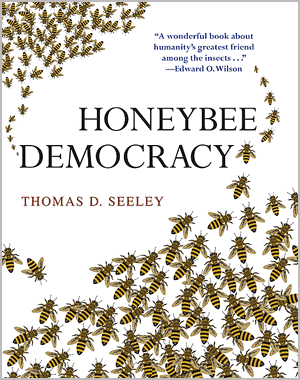
Learn from Bees

In the final chapter, Seeley suggests five lessons we could learn from bees.

• Compose a decision-making group of individuals with shared interests. Here bees have a higher stake than us: all members of a colony are related (sisters) and nobody can survive without the group.

• Minimise the leader's influence on the group. Here we humans have much to learn.

• Seek diverse solutions to the problem. Humans realised only recently that diversity is good for a group.

• Update the group's knowledge through debate. Here again, bees are superior to us, as each scout's "dances" become less effective with time, no matter how good a new site is, while stubbornness can lead humans to argue forever.

• Use quorums to gain cohesion, accuracy and speed. Impressively, bees came up with this concept long before the Greeks.

Friday, July 23, 2010

Sunday, July 18, 2010

A very coold ad

Soccer's greatest ever for some.